
Die Application Gallery bietet COMSOL Multiphysics® Tutorial- und Demo-App-Dateien, die für die Bereiche Elektromagnetik, Strukturmechanik, Akustik, Strömung, Wärmetransport und Chemie relevant sind. Sie können diese Beispiele als Ausgangspunkt für Ihre eigene Simulationsarbeit verwenden, indem Sie das Tutorial-Modell oder die Demo-App-Datei und die dazugehörigen Anleitungen herunterladen.
Suchen Sie über die Schnellsuche nach Tutorials und Apps, die für Ihr Fachgebiet relevant sind. Beachten Sie, dass viele der hier vorgestellten Beispiele auch über die Application Libraries zugänglich sind, die in die COMSOL Multiphysics® Software integriert und über das Menü File verfügbar sind.

In diesem Beispiel werden drei verschiedene Modelle für einen Lateral-Flow-Test zum Nachweis von Coronavirus-Antikörpern vorgestellt. Ein 3D-Modell untersucht mögliche Symmetrien bei der Ausbreitung der flüssigen Probe im Teststreifen. Das 3D-Modell zeigt, dass der Fluss im ... Mehr lesen

Die Hauptverteidigung eines U-Boots besteht in seiner Fähigkeit, während der Fahrt verborgen zu bleiben. Da Radiowellen vom Meerwasser stark absorbiert werden, ist Sonar eine der wichtigsten Methoden zum Aufspüren von U-Booten. Sonarsysteme werden auch bei der Unterwasserforschung und in ... Mehr lesen
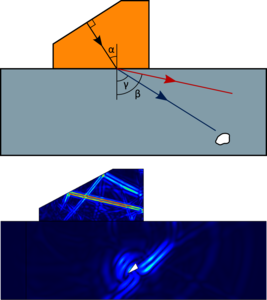
Ultraschall-Winkelprüfsysteme werden für die zerstörungsfreie Prüfung von festen Objekten, wie Metallrohren, verwendet. Sie sind besonders nützlich für die Erkennung von Fehlern in und um Schweißbereiche, wie Poren, kleine Risse oder fehlende Verschmelzung. Die zerstörungsfreie Prüfung ... Mehr lesen
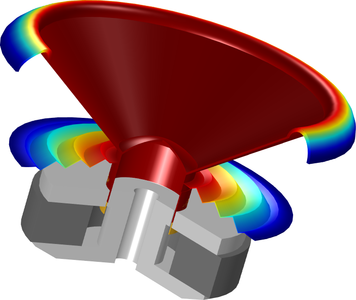
Dieses Beispiel zeigt, wie Sie einen Lautsprecher MIT dynamischem Konus modellieren können, der für niedrige und mittlere Frequenzen verwendet wird. Die Analyse wird im Frequenzbereich durchgeführt und stellt somit das lineare Verhalten des Treibers dar. Die Modellanalyse umfasst die ... Mehr lesen

This tutorial demonstrate the use of a Cross Grating feature in an échelle spectrograph. A cross grating is a periodic surface with two directions of periodicity. In this model the cross grating is used in high order in one direction and in first order in the orthogonal ("cross") ... Mehr lesen
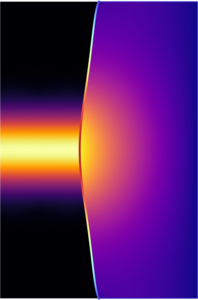
The thermal effects of a laser beam incident on a Semiconductor Saturable Absorber Mirror (SESAM) are simulated under a range of incident beam powers. This is done in two steps. The first study simulates the multiphysics combination of the saturated absorption of the beam on a SESAM, ... Mehr lesen
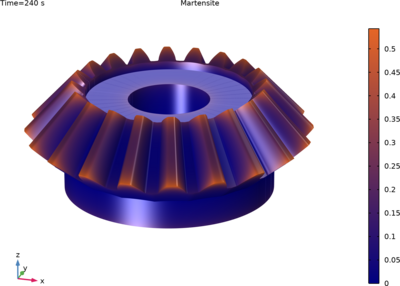
A 3D model is used to simulate the cooling of a bevel gear from an austenitic state. Phase material properties and phase transformation data are imported into the model. The final phase composition and the residual stress state are computed. Phenomena such as thermal strains, phase ... Mehr lesen
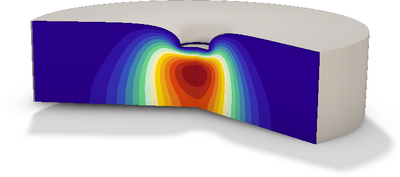
This example demonstrates how to use the Poroelasticity multiphysics coupling between the Solid Mechanics and Darcy's Law interfaces to model linear biphasic poroviscoelastic behavior of soft biological tissues. The implementation is verified using two numerical benchmarks from the ... Mehr lesen
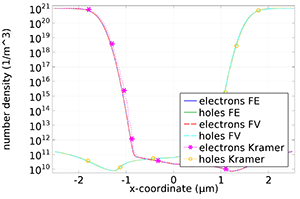
This simple benchmark model computes the potential and carrier concentrations for a one-dimensional p-n junction using both the finite element and finite volume methods. The results are compared with an equivalent device from the book, "Semiconductor Devices: A Simulation Approach," by ... Mehr lesen

This presentation shows how to use the Optimization Module to fit a material model curve to experimental data. It is based on the hyperelastic Mooney-Rivlin material model example given in the Structural Mechanics users guide. Mehr lesen


