
Die Application Gallery bietet COMSOL Multiphysics® Tutorial- und Demo-App-Dateien, die für die Bereiche Elektromagnetik, Strukturmechanik, Akustik, Strömung, Wärmetransport und Chemie relevant sind. Sie können diese Beispiele als Ausgangspunkt für Ihre eigene Simulationsarbeit verwenden, indem Sie das Tutorial-Modell oder die Demo-App-Datei und die dazugehörigen Anleitungen herunterladen.
Suchen Sie über die Schnellsuche nach Tutorials und Apps, die für Ihr Fachgebiet relevant sind. Beachten Sie, dass viele der hier vorgestellten Beispiele auch über die Application Libraries zugänglich sind, die in die COMSOL Multiphysics® Software integriert und über das Menü File verfügbar sind.
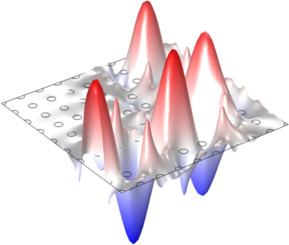
Photonische Kristalle sind periodische Strukturen aus abwechselnden Schichten von Materialien mit unterschiedlichen Brechungsindizes. Wellenleiter, die in einem photonischen Kristall eingeschlossen sind, können sehr scharfe, verlustarme Biegungen aufweisen, was eine Erhöhung der ... Mehr lesen
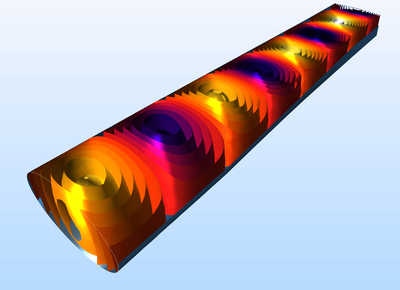
Dies ist ein Modell eines Adapters für die Mikrowellenausbreitung im Übergang zwischen einem rechteckigen und einem elliptischen Wellenleiter. Solche Wellenleiteradapter sind so konzipiert, dass die Energieverluste aufgrund von Reflexionen bei den Betriebsfrequenzen minimal sind. Um die ... Mehr lesen

The model demonstrates the basics of the 3-omega method. The coupled electromagnetic heating problem is solved in a solid sample which is heated by a thin copper strip, deposited on the surface of a sample. Analyzing the frequency dependence of the voltage oscillation amplitude, we ... Mehr lesen
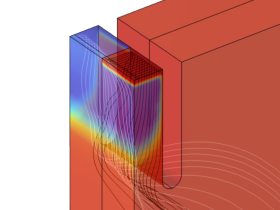
In this second half of a two-part example, a 3D model of a trench-gate IGBT is built by extruding the 2D model from the first half. Unlike the 2D model, now it is possible to arrange the alternating n+ and p+ emitters along the direction of extrusion as in the real device. This more ... Mehr lesen

Optical lenses of millimeter size cannot easily be analyzed with the Electromagnetic Waves, Frequency Domain interface on standard workstations due to the large number of finite element mesh elements required. This model explains how the Electromagnetic Waves, Beam Envelopes interface ... Mehr lesen
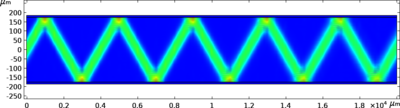
The bidirectional formulation of the Beam Envelopes interface can be used not only for counter-propagating wave simulations but also for waves propagating to up to two directions. In this model, an almost collimated Gaussian beam is excited at the left boundary and exhibits total ... Mehr lesen
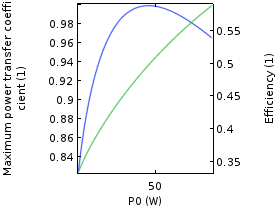
This tutorial drives a capacitively coupled plasma with an L-type matching network at high and low powers. At low power, where the harmonics in the current are low, prefect matching is obtained at the chosen power value. Sweeps over power, frequency, and pressure are performed and their ... Mehr lesen

This example reproduces parts of the study of Ref. 1 on the thermal contact resistance at the interface between a heat sink and an electronic package. Eight cooling fins equip the cylindrical heat sink and contact is made at the radial boundaries of the package. The efficiency of the ... Mehr lesen
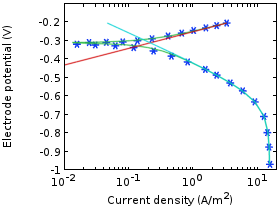
This tutorial shows how to use the Optimization interface to perform electrode kinetics parameter estimations based on polarization data. A zero-dimensional electrode polarization model is defined that separates kinetics expressions for the metal dissolution and the oxygen reduction ... Mehr lesen

The Boltzmann equation can be solved to validate sets of electron impact collision cross sections. In fact, sets of collision cross sections are traditionally inferred by solving a two-term approximation to the Boltzmann equation and comparing the results to swarm experiments. This model ... Mehr lesen


