
Die Application Gallery bietet COMSOL Multiphysics® Tutorial- und Demo-App-Dateien, die für die Bereiche Elektromagnetik, Strukturmechanik, Akustik, Strömung, Wärmetransport und Chemie relevant sind. Sie können diese Beispiele als Ausgangspunkt für Ihre eigene Simulationsarbeit verwenden, indem Sie das Tutorial-Modell oder die Demo-App-Datei und die dazugehörigen Anleitungen herunterladen.
Suchen Sie über die Schnellsuche nach Tutorials und Apps, die für Ihr Fachgebiet relevant sind. Beachten Sie, dass viele der hier vorgestellten Beispiele auch über die Application Libraries zugänglich sind, die in die COMSOL Multiphysics® Software integriert und über das Menü File verfügbar sind.
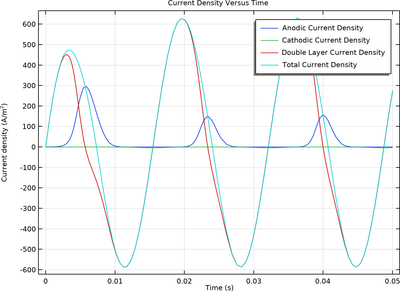
Corrosion induced due to alternating current (AC) is evident in the oil and gas industry, particularly when a pipeline is in close proximity to the high power transmission lines. A numerical model presented here first evaluates the effect of direct current (DC) applied potential on ... Mehr lesen

The mutual inductance between a primary and secondary single turn coil in a concentric coplanar arrangement is computed using a DC, steady-state, model and compared against the analytic solution. The induced currents in the secondary coil are computed using an AC, frequency-domain, ... Mehr lesen
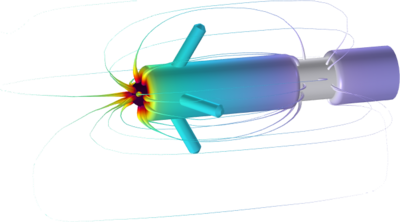
Dieses Modell veranschaulicht die Verwendung von COMSOL Multiphysics für die Modellierung von Problemen der Ionenstromverteilung in Elektrolyten, in diesem Fall in menschlichem Gewebe. Das Problem wird anhand einer Herzschrittmacher-Elektrode veranschaulicht, lässt sich aber auch auf ... Mehr lesen

Dieses Modell stellt eine Studie über die Stromdichteverteilung in einer Festoxid-Brennstoffzelle (SOFC) vor. Das Modell umfasst die vollständige Kopplung zwischen den Massenbilanzen an der Anode und der Kathode, den Impulsbilanzen in den Gaskanälen, dem Gasfluss in den porösen ... Mehr lesen
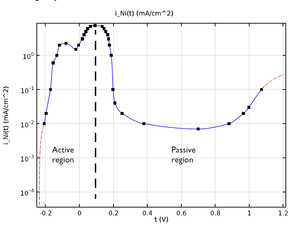
This model exemplifies the basic principles of crevice corrosion and how a time-dependent study can be used to simulate the electrode deformation. The model is in 2D and the polarization data for the corrosion reaction is taken from a paper by Absulsalam and others. The model and the ... Mehr lesen
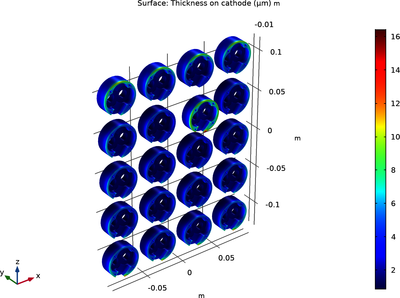
When several components are to be electroplated they are typically mounted on a rack in the electroplating bath. An important aspect is then achieving a uniform thickness of the plated layer for all components mounted on the rack. This example model allows for investigating the effect ... Mehr lesen

The zinc bromine redox flow battery is an electrochemical energy storage technology suitable for stationary applications. Compared to other flow battery chemistries, the Zn-Br cell potentially features lower cost, higher energy densities and better energy efficiencies. In the cell ... Mehr lesen
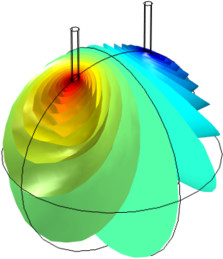
This tutorial example models the currents and the concentration of dissolved metal ions in a battery (corrosion cell) made from an orange and two metal nails. This type of battery is commonly used in chemistry lessons. Instead of an orange, lemons or potatoes can also be used. Mehr lesen
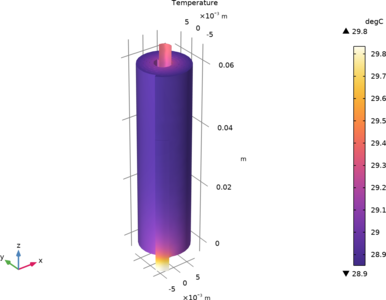
In einer zylindrischen oder prismatischen Batteriezelle werden die aktiven Schichten, die Stromabnehmer-Metallfolien und die Separatoren zu einer „Jelly Roll“ gewickelt. Zusätzliche Laschen (Metallstreifen) werden an die Stromabnehmerfolien geschweißt, um den Strom zur Außenseite der ... Mehr lesen
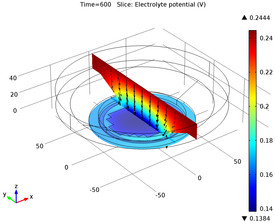
This example models time-dependent copper deposition on a resistive wafer in a cupplater reactor. As the deposited layer builds up, the resistive losses of the deposited layer decreases. The benefit of using a current thief for a more uniform deposit is demonstrated. Mehr lesen