
Die Application Gallery bietet COMSOL Multiphysics® Tutorial- und Demo-App-Dateien, die für die Bereiche Elektromagnetik, Strukturmechanik, Akustik, Strömung, Wärmetransport und Chemie relevant sind. Sie können diese Beispiele als Ausgangspunkt für Ihre eigene Simulationsarbeit verwenden, indem Sie das Tutorial-Modell oder die Demo-App-Datei und die dazugehörigen Anleitungen herunterladen.
Suchen Sie über die Schnellsuche nach Tutorials und Apps, die für Ihr Fachgebiet relevant sind. Beachten Sie, dass viele der hier vorgestellten Beispiele auch über die Application Libraries zugänglich sind, die in die COMSOL Multiphysics® Software integriert und über das Menü File verfügbar sind.

The engine block of a car includes a cooling jacket to remove excess heat from combustion. The cooling jacket consists of open spaces in the cylinder block and the cylinder head. When the engine is running, a coolant fluid is pumped through the jacket to keep the engine from overheating. ... Mehr lesen
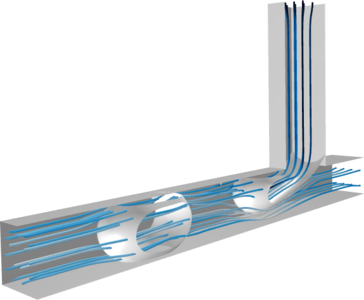
Emulsionen bestehen aus kleinen Flüssigkeitströpfchen, die in eine nicht mit ihnen mischbare Flüssigkeit eingetaucht sind, und kommen häufig bei der Herstellung von Lebensmitteln, Kosmetika, Feinchemikalien und pharmazeutischen Produkten vor. Die Qualität des Produkts ist in der Regel ... Mehr lesen
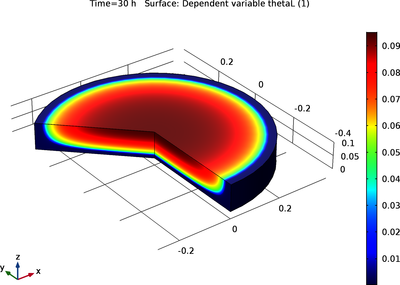
Die Vakuumtrocknung ist ein chemischer Prozess, der häufig in der Pharma- und Lebensmittelindustrie eingesetzt wird, um Wasser oder ein organisches Lösungsmittel aus einem feuchten Pulver zu entfernen. Bei der Entwicklung eines Vakuumtrocknungssystems zielen die Ingenieure darauf ab, die ... Mehr lesen

This example simulates the thermodynamical evolution of moist air in an electronic box with the aim of detecting whether condensation occurs when the external environment properties change. The model imports measured data for the air temperature, pressure, and water vapor concentration. ... Mehr lesen
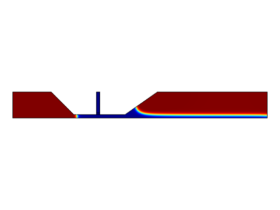
This tutorial shows how to model a slot die coating process with a power-law non-Newtonian fluid in one of the two phases. The model uses a two-phase flow phase-field method. Mehr lesen
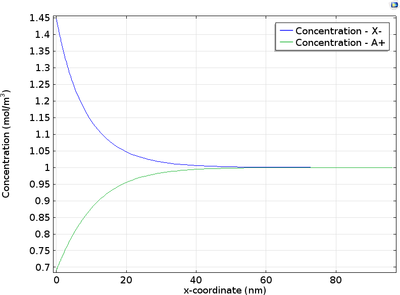
An der Elektroden-Elektrolyt-Grenzfläche befindet sich eine dünne Schicht von Raumladungen in einer diffusen Doppelschicht. Dies kann bei der Modellierung von Geräten wie elektrochemischen Kondensatoren und Nanoelektroden von Interesse sein. Dieses Tutorial-Beispiel zeigt, wie man die ... Mehr lesen
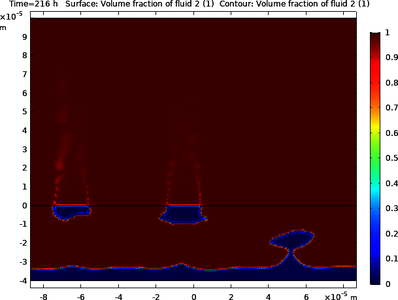
This example models galvanic corrosion between two different phases in a magnesium alloy for a representative cross-sectional microstructure configuration. The Phase Field interface is used here to model dissolution of a constituent phase leading to topological changes. The electrode ... Mehr lesen
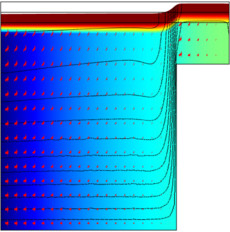
The Poroelasticity interface couples Darcy's law and solid mechanics to assess deformation of porous media that results from fluid withdrawals. The model builds on top of the Terzaghi Compaction example. Results from Terzaghi compaction and Biot poroelasticity analyses are compared to ... Mehr lesen
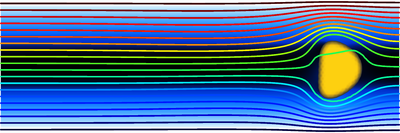
Applying an electric field across a suspension of immiscible liquids may stimulate droplets of the same phase to coalesce. The method known as electrocoalescence has important applications, for instance, in the separation of oil from water. To model electrocoalescence, you need to solve ... Mehr lesen
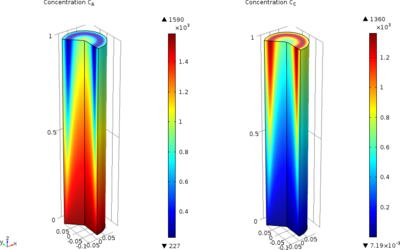
This application uses the Chemical Reaction Engineering Module to study an elementary, exothermic, irreversible reaction in a tubular reactor (liquid phase, laminar flow regime). To keep its temperature down, the reactor uses a cooling jacket with a constant coolant temperature. The ... Mehr lesen


