
Die Application Gallery bietet COMSOL Multiphysics® Tutorial- und Demo-App-Dateien, die für die Bereiche Elektromagnetik, Strukturmechanik, Akustik, Strömung, Wärmetransport und Chemie relevant sind. Sie können diese Beispiele als Ausgangspunkt für Ihre eigene Simulationsarbeit verwenden, indem Sie das Tutorial-Modell oder die Demo-App-Datei und die dazugehörigen Anleitungen herunterladen.
Suchen Sie über die Schnellsuche nach Tutorials und Apps, die für Ihr Fachgebiet relevant sind. Beachten Sie, dass viele der hier vorgestellten Beispiele auch über die Application Libraries zugänglich sind, die in die COMSOL Multiphysics® Software integriert und über das Menü File verfügbar sind.
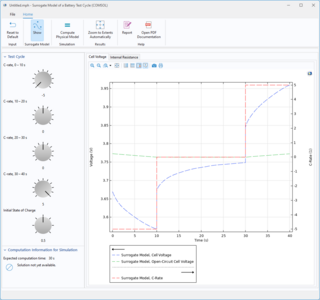
Diese App demonstriert die Verwendung eines Ersatzmodells zur Vorhersage der Zellspannung, der Leerlaufspannung und des Innenwiderstands einer NMC111/Graphit-Batteriezelle, die einem Batterietestzyklus unterzogen wird. Das Ersatzmodell, ein Deep Neural Network, wurde an einen Teil der ... Mehr lesen
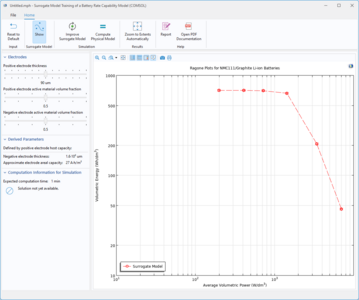
Diese App demonstriert die Verwendung einer Ersatzmodellfunktion zur Vorhersage der Ratenfähigkeit einer NMC111/Graphit-Akkuzelle. Die Ratenfähigkeit wird in einem Ragone-Diagramm dargestellt. Die Ersatzfunktion, ein Deep Neural Network, wurde an eine Teilmenge der möglichen ... Mehr lesen
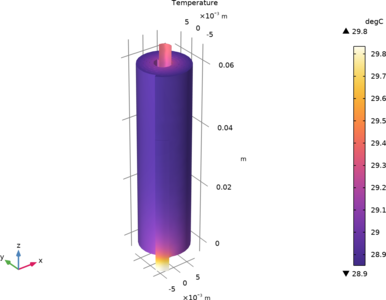
In einer zylindrischen oder prismatischen Batteriezelle werden die aktiven Schichten, die Stromabnehmer-Metallfolien und die Separatoren zu einer „Jelly Roll“ gewickelt. Zusätzliche Laschen (Metallstreifen) werden an die Stromabnehmerfolien geschweißt, um den Strom zur Außenseite der ... Mehr lesen
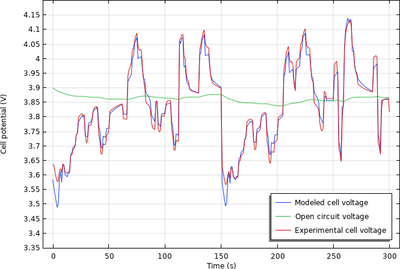
This tutorial uses an equivalent circuit approach for modeling the performance of a lithium-ion battery, requiring no knowledge about the internal chemistry or structure of the battery. A 0D equivalent circuit battery model is defined based on a resistor connected in series with a ... Mehr lesen
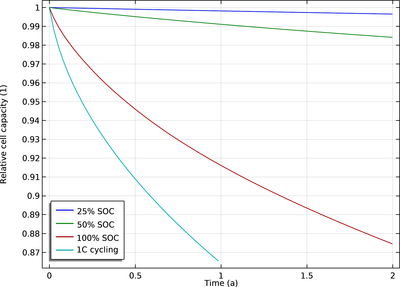
This tutorial demonstrates the Lumped Battery interface for modeling capacity loss in a battery. A set of lumped parameters are used to describe the capacity loss that occurs due to parasitic reactions in the battery, assuming no knowledge of the internal structure or design of the ... Mehr lesen
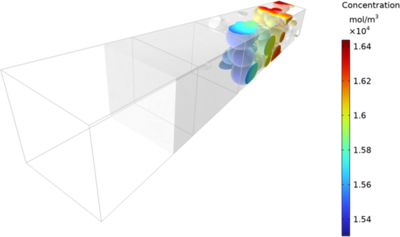
Solid-state batteries (SSB) are a promising technology that could suffer from internal mechanical stresses due to the growth and shrinkage of the electrodes within all-solid components. With this model, the charge-discharge cycling of an SSB is simulated with a focus on the interaction ... Mehr lesen
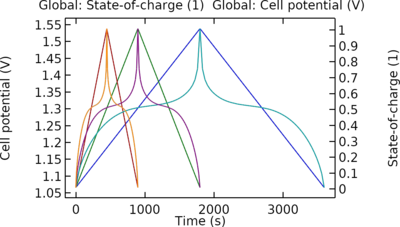
A simple equivalent circuit model approach is presented for Nickel metal hydride batteries. The 0D model consists of resistor, capacitor, current source and state-of-charge based voltage source (SOC). An Arrhenius type dependence is used to account for self-discharge. All model ... Mehr lesen
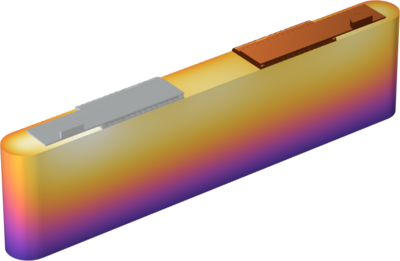
This model exemplifies how to compute the internal temperature distribution in a prismatic battery during a high-rate charge. The electrochemistry is described by a a lumped two-electrode model, which is coupled to the heat transfer model. The heat transfer model includes the effects of ... Mehr lesen
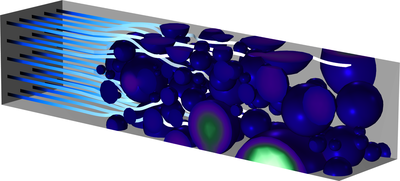
In diesem Beispiel wird eine heterogene NMC-Elektrodenstruktur (Nickel-Mangan-Kobalt) mit Hilfe einer Modellmethode aus Tomographiedaten erzeugt. Anschließend werden Simulationen der zeitabhängigen Entladung und der elektrochemischen Impedanzspektroskopie (EIS) an der vollständigen 3D ... Mehr lesen
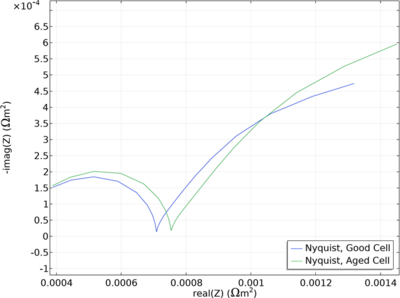
The model used is the P2D model also called the Newman model. Parameter estimation is run using experimental data of driving cycles from healthy cells. The parameter values are determined for a confidence of 0.95 for each parameter. Parameter estimation is then run using data from ... Mehr lesen


