
Die Application Gallery bietet COMSOL Multiphysics® Tutorial- und Demo-App-Dateien, die für die Bereiche Elektromagnetik, Strukturmechanik, Akustik, Strömung, Wärmetransport und Chemie relevant sind. Sie können diese Beispiele als Ausgangspunkt für Ihre eigene Simulationsarbeit verwenden, indem Sie das Tutorial-Modell oder die Demo-App-Datei und die dazugehörigen Anleitungen herunterladen.
Suchen Sie über die Schnellsuche nach Tutorials und Apps, die für Ihr Fachgebiet relevant sind. Beachten Sie, dass viele der hier vorgestellten Beispiele auch über die Application Libraries zugänglich sind, die in die COMSOL Multiphysics® Software integriert und über das Menü File verfügbar sind.
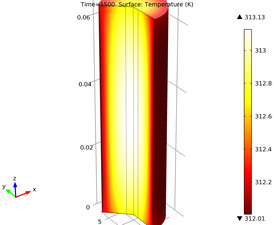
Dieses Modellbeispiel simuliert einen luftgekühlten zylindrischen 18650-Lithium-Ionen-Akku während eines Lade-Entlade-Zyklus, gefolgt von einer Erholungsphase. Ein (0D) Lumped-Modell einer Zelle wird verwendet, um die Zellchemie des Akkus zu modellieren, und ein zweidimensionales ... Mehr lesen

Ein Getriebe dient der Kraftübertragung von einem Motor auf die zugehörigen Räder oder Zahnräder, was zu einer Geräuschabstrahlung in die Umgebung führen kann. Dies ist auf die Übertragung unerwünschter lateraler und axialer Kräfte auf die Lager und das Gehäuse zurückzuführen, während ... Mehr lesen

This model shows how you can use the Non-Isothermal Pipe Flow interface together with the Heat Transfer in Solids interface to model the cooling of a injection molded polyurethane part for a car steering wheel. The equations describing the cooling channels are fully coupled to the heat ... Mehr lesen
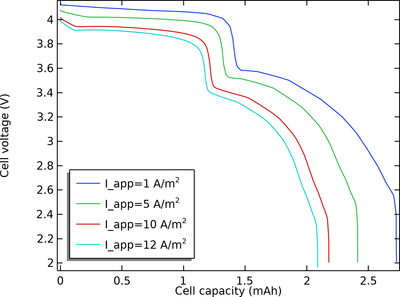
Sodium-ion batteries (SIB) are commonly presented as an alternative to lithium-ion batteries (LIB). The SIB chemistry uses Na+ instead of Li+ for electrolyte charge transport and as redox species in the electrode reactions, with the advantage of Na+ being more abundant and with a ... Mehr lesen
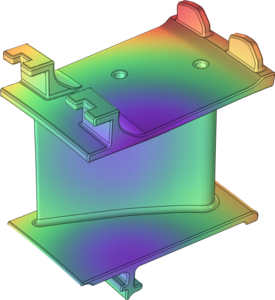
This example shows how to compute thermally induced stresses in a turbine stator blade using the Thermal Stress, Solid interface. The conditions within gas turbines are extreme. The pressure can be as high as 40 bar, and the temperature more than 1000 K. Any new component must therefore ... Mehr lesen
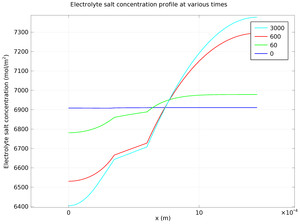
This model simulates the discharge of a Nickel-Metal Hydride (NiMH) battery using the Battery with Binary Electrolyte interface. The geometry is in one dimension and the model is isothermal. The model serves as an introduction to NiMH modeling, and can be further extended to include ... Mehr lesen
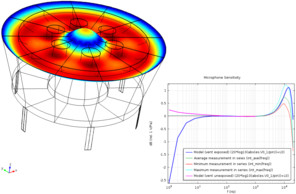
This is a model of the Brüel and Kjær 4134 condenser microphone. The geometry and material parameters are those of the actual microphone. The modeled sensitivity level is compared to measurements performed on an actual microphone and shows good agreement. The membrane deformation, ... Mehr lesen
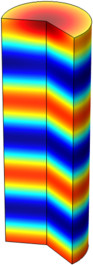
In this model, sound created by a vibrating piston radiates through a baffled pipe. The impedance is measured and then used in an impedance boundary condition that replaces the surrounding air domain. This technique can be employed to reduce solution time and memory usage for large ... Mehr lesen

Many applications involve simulating the electromagnetic behavior of relatively thin material in voluminous domains. To save computer memory and processing time, the thin materials can be treated differently by resolving them with 3D meshes. Here, the modeling domain is a box filled ... Mehr lesen

This tutorial shows how you can use the Electromechanics interface in COMSOL's MEMS Module to model Electrostriction. Electrostrictive materials (e.g. PMN-PT) exhibit nonlinear strain as a function of electric field. This 2D axisymmetry model uses a parametric sweep of voltage to ... Mehr lesen