
Die Application Gallery bietet COMSOL Multiphysics® Tutorial- und Demo-App-Dateien, die für die Bereiche Elektromagnetik, Strukturmechanik, Akustik, Strömung, Wärmetransport und Chemie relevant sind. Sie können diese Beispiele als Ausgangspunkt für Ihre eigene Simulationsarbeit verwenden, indem Sie das Tutorial-Modell oder die Demo-App-Datei und die dazugehörigen Anleitungen herunterladen.
Suchen Sie über die Schnellsuche nach Tutorials und Apps, die für Ihr Fachgebiet relevant sind. Beachten Sie, dass viele der hier vorgestellten Beispiele auch über die Application Libraries zugänglich sind, die in die COMSOL Multiphysics® Software integriert und über das Menü File verfügbar sind.

The principle component of a quadrupole mass spectrometer is the mass filter which is used to filter ions with different charge to mass ratios. The quadrupole mass filter has been well studied over the years, Ref. 1 and the physics and optimal design are well understood. In a real ... Mehr lesen
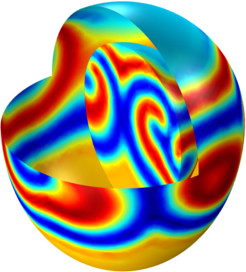
Die Modellierung der elektrischen Aktivität im Herzgewebe ist ein wichtiger Schritt zum Verständnis der Muster von Kontraktionen und Dilatationen im Herzen. Das Herz erzeugt rhythmische elektrische Impulse, die die mechanischen Kontraktionen des Muskels auslösen. Bei einer Reihe von ... Mehr lesen

In diesem Modell ist ein Knowles-ED23146-Receiver (Miniaturlautsprecher) mit einem Testaufbau verbunden, der aus einem 50 mm (1 mm Durchmesser) Ohrpassstück und einem so genannten 0.4-cc-Koppler besteht. Der Empfänger wird mit einem Lumped-Spice-Netzwerk modelliert und am Röhreneingang ... Mehr lesen
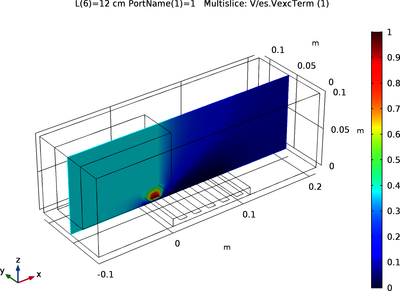
This tutorial model explains how to extract lumped matrices by means of the Stationary Source Sweep study. The capacitance matrix of a five-terminal system is used to infer the position of a metallic object similar to real-world capacitive position sensors. The example illustrates the ... Mehr lesen

This tutorial example shows how to use the Electric Currents in Shells interface together with Magnetic Field interface to compute the resistance and inductance of a planar PCB coil in the stationary regime. Mehr lesen
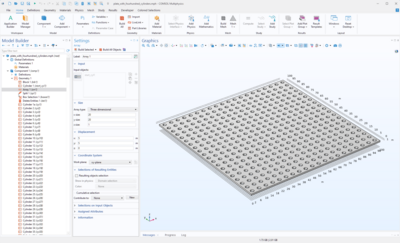
This collection of examples demonstrates how to use the COMSOL® API with the Java® programming language, as described in the Application Programming Guide under Programming Examples. Please note that these examples are simplified for clarity and do not include error handling or ... Mehr lesen
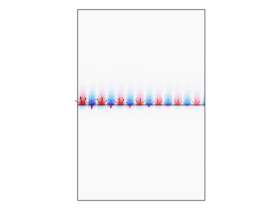
Electromagnetic waves that are confined to propagate along a surface, such as surface plasmon polaritons (SPPs), are of great research interest due to their potential applications in nanoscale manipulation of light. This model demonstrates how to set up a simulation of the propagation ... Mehr lesen

A differential line is composed of two transmission lines excited by two out-of-phase signals. This configuration is known to be useful to enhance signal-to-noise ratio. This example shows how to set up the differential microstrip lines using TEM type ports. Mehr lesen


