
Die Application Gallery bietet COMSOL Multiphysics® Tutorial- und Demo-App-Dateien, die für die Bereiche Elektromagnetik, Strukturmechanik, Akustik, Strömung, Wärmetransport und Chemie relevant sind. Sie können diese Beispiele als Ausgangspunkt für Ihre eigene Simulationsarbeit verwenden, indem Sie das Tutorial-Modell oder die Demo-App-Datei und die dazugehörigen Anleitungen herunterladen.
Suchen Sie über die Schnellsuche nach Tutorials und Apps, die für Ihr Fachgebiet relevant sind. Beachten Sie, dass viele der hier vorgestellten Beispiele auch über die Application Libraries zugänglich sind, die in die COMSOL Multiphysics® Software integriert und über das Menü File verfügbar sind.
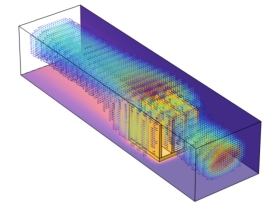
Dieses Tutorial-Modell verwendet eine Kühlkörpergeometrie aus der Part Library. Das Tutorial zeigt verschiedene Ansätze zur Modellierung des Wärmetransports bei der Untersuchung der Kühlung eines elektronischen Chips. Im ersten Teil werden nur die festen Teile modelliert, während der ... Mehr lesen
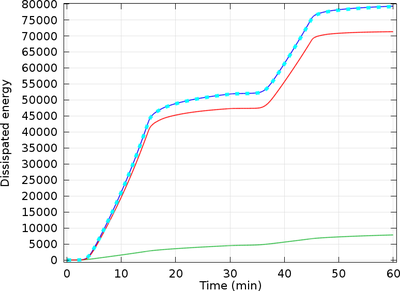
Fatigue testing of nonlinear materials with creep mechanism is a time-consuming process. In accelerated life testing the experiment time is greatly reduced by subjecting the material to testing conditions in excess of the operating one. In the model an aggressive thermal load cycle is ... Mehr lesen

This model studies the temperature effects on the viscoelastic stress relaxation in a long thick-walled cylinder. In particular, decay of the stresses under the influence of the temperature field during a period of two hours is studied. A four-term generalized Maxwell model represents ... Mehr lesen

This model shows how to use simulations to predict power numbers with Power Law fluids in a mixer. It simulates the behavior of flow in a flat bottom tank with a single four-blade pitched impeller. The flow was modeled as laminar and the frozen rotor approach was used to solve the ... Mehr lesen
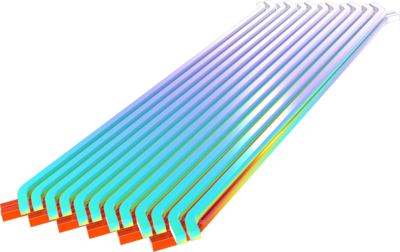
In a polymer electrolyte membrane fuel cell (PEMFC), water is produced at the cathode. The cell is also fed with water vapor via the inlet gas streams, in order to keep the polymer electrolyte membrane humidified. If the water partial pressure in the gas phase exceeds the vapor ... Mehr lesen
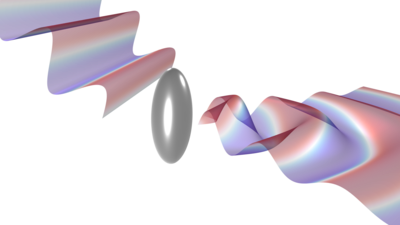
Electromagnetic scattering simulation for an object with continuous rotational symmetry can be performed in 2D axisymmetry instead of 3D to drastically reduce computational time and resources. This model shows how to simulate arbitrary plane wave incidence in 2D axisymmetric models by ... Mehr lesen

One of the ways we can simplify and reduce the size and computational complexity of a finite element model is by using any symmetries present in a model. In this entry, you can find three practical examples highlighting how to exploit symmetries in RF or wave optics modeling. They all ... Mehr lesen
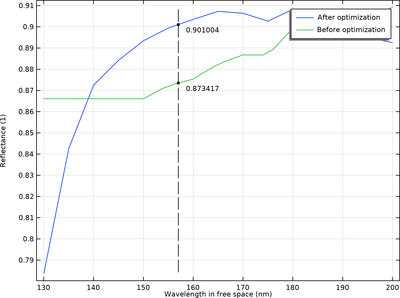
This example demonstrates how to optimize the thickness of a microelectromechanical systems (MEMS) mirror coating material for maximum reflectivity. To reduce the simulation time, a Layered Impedance Boundary Condition is used to model the thin coating material on top of the metallic ... Mehr lesen
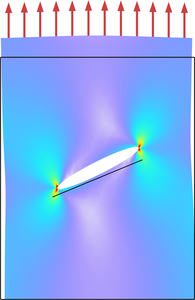
This example reproduces a NAFEMS benchmark in which a plate with an angle crack is subjected to tensile loading. The J-integral is calculated and the stress intensity factors for Mode I and Mode II are compared to the benchmark results for several crack angles. Mehr lesen

This conceptual example shows how to handle a transient contact problem with stick-slip friction transition. A soft hollow pipe subjected to gravity is released at the top of a halfpipe. The pipe motion varies between sliding and rolling, depending on its position in the halfpipe and its ... Mehr lesen