
Die Application Gallery bietet COMSOL Multiphysics® Tutorial- und Demo-App-Dateien, die für die Bereiche Elektromagnetik, Strukturmechanik, Akustik, Strömung, Wärmetransport und Chemie relevant sind. Sie können diese Beispiele als Ausgangspunkt für Ihre eigene Simulationsarbeit verwenden, indem Sie das Tutorial-Modell oder die Demo-App-Datei und die dazugehörigen Anleitungen herunterladen.
Suchen Sie über die Schnellsuche nach Tutorials und Apps, die für Ihr Fachgebiet relevant sind. Beachten Sie, dass viele der hier vorgestellten Beispiele auch über die Application Libraries zugänglich sind, die in die COMSOL Multiphysics® Software integriert und über das Menü File verfügbar sind.
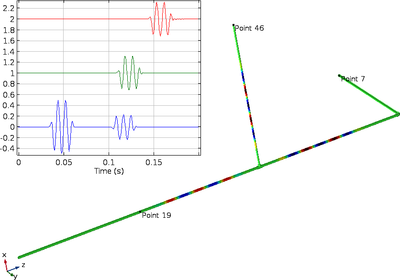
This tutorial shows how to model the propagation of acoustic waves in large pipe systems by coupling the Pipe Acoustics interface to the Pressure Acoustics interface. The tutorial is set up in both the time domain and the frequency domain. 1D pipe acoustics is used to model the ... Mehr lesen

Dieses Modell zeigt, wie Sie mit dem Feature Control Function die Form eines rechteckigen Horns optimieren können, um eine bessere Antwort auf der Achse zu erzielen. Die Ergebnisse des ursprünglichen Designs werden über einen Filter-Datensatz in eine neue Komponente exportiert. Außerdem ... Mehr lesen

This tutorial model presents a study showing the transient negative mobility and the negative differential conductivity effects in xenon. The stationary and time dependent Boltzmann equation in the two-term approximation is used to compute the electron energy distribution function. ... Mehr lesen

Dieses Tutorial zeigt, wie Sie vollständige vibro-elektroakustische 3D-Multiphysik-Modelle von Lautsprechern am besten lösen. Das Modell basiert auf einer 3D-Darstellung des bestehenden achsensymmetrischen 2D-Modells loudspeaker_driver aus der Application Library der Software. Der Aufbau ... Mehr lesen

In this example, a dynamic analysis of a three-cylinder reciprocating engine is performed to investigate stresses generated during operation, thereby permitting identification of the critical components. Demand for high power output relative to the weight of the engine requires careful ... Mehr lesen
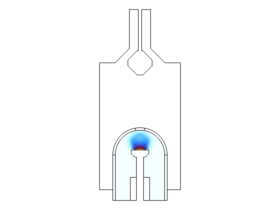
This tutorial model solves for a hydrogen plasma created in a microwave cavity. The model computes the fluid flow and gas heating self-consistently. Mehr lesen
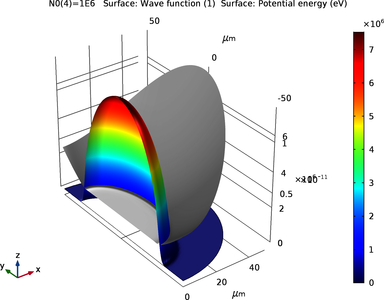
This tutorial model solves the Gross–Pitaevskii Equation for the ground state of a Bose–Einstein condensate in a harmonic trap, using the Schrödinger Equation interface in the Semiconductor Module. The equation is essentially a nonlinear single-particle Schrödinger Equation, with a ... Mehr lesen
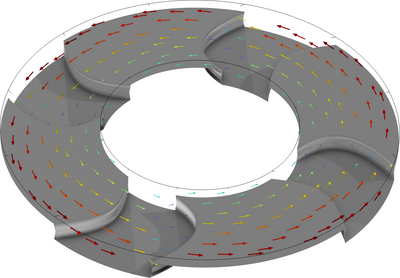
In this tutorial model, a step thrust bearing is shape optimized to maximize the bearing capacity. A step thrust bearing consists of a stepped bearing surface on which the end of the shaft rotates. The entire assembly is submerged in a lubricant. The shaft collar is assumed to be ... Mehr lesen
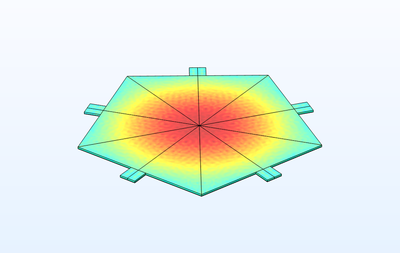
This tutorial demonstrates how an electrical circuit model of a MEMS resonator can be derived using the Parameter Estimation feature. The model is a modified Butterworth-Van Dyke circuit created using the Electrical Circuit interface and represents a Thin-Film Bulk Acoustic Resonator ... Mehr lesen
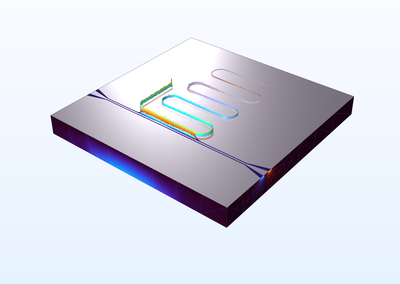
Developments in the last decade have made circuit quantum electrodynamics (cQED) the leading architecture for quantum computation. cQED is the solid-state version of cavity QED, which studies the basic light-matter interactions at the quantum level. This model examines one of the main ... Mehr lesen