
Die Application Gallery bietet COMSOL Multiphysics® Tutorial- und Demo-App-Dateien, die für die Bereiche Elektromagnetik, Strukturmechanik, Akustik, Strömung, Wärmetransport und Chemie relevant sind. Sie können diese Beispiele als Ausgangspunkt für Ihre eigene Simulationsarbeit verwenden, indem Sie das Tutorial-Modell oder die Demo-App-Datei und die dazugehörigen Anleitungen herunterladen.
Suchen Sie über die Schnellsuche nach Tutorials und Apps, die für Ihr Fachgebiet relevant sind. Beachten Sie, dass viele der hier vorgestellten Beispiele auch über die Application Libraries zugänglich sind, die in die COMSOL Multiphysics® Software integriert und über das Menü File verfügbar sind.
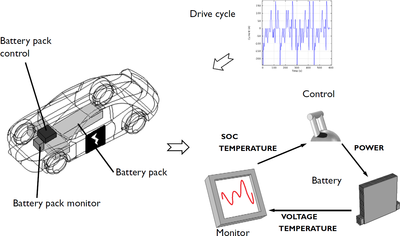
This application shows how a battery cell exposed to a hybrid electric vehicle drive cycle can be investigated with the Lithium-Ion Battery interface in COMSOL. This model predicts the battery behavior to make comparisons of the monitored properties. They can be used to understand the ... Mehr lesen
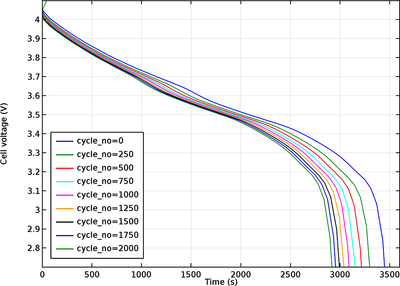
Nebenreaktionen und Degradationsprozesse können zu einer Reihe von unerwünschten Effekten führen, die einen Kapazitätsverlust in Lithium-Ionen-Akkus verursachen. Typischerweise erfolgt die Alterung aufgrund mehrerer komplexer Phänomene und Reaktionen, die gleichzeitig an verschiedenen ... Mehr lesen
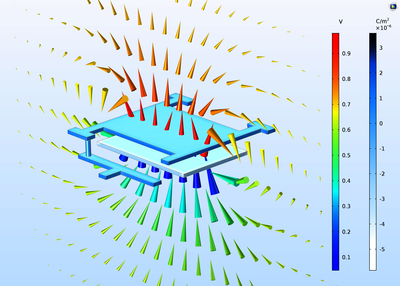
The electrostatically tunable parallel plate capacitor in this example is a typical component in various MEMS devices for radio frequencies that range between 300 MHz and 300 GHz. You can modify the distance between the two plates, as the applied voltage changes, through a spring ... Mehr lesen
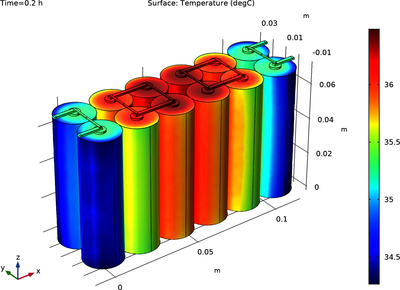
Dieses Beispiel zeigt, wie Sie die Temperaturverteilung in einem Akkupack während einer 4C-Entladung modellieren können. Das Paket wird aufgebaut, indem zunächst zwei zylindrische Akkus parallel geschaltet werden. Sechs parallel geschaltete Paare werden dann in Reihe geschaltet, um den ... Mehr lesen
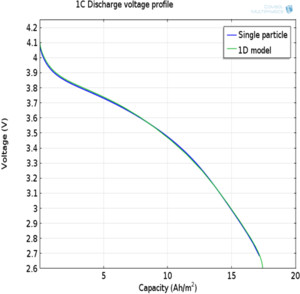
An isothermal single particle model formulation for a lithium-ion battery is presented in this work. The single particle model is a simplification of the 1D formulation for a lithium-ion battery along with a few assumptions. The model is typically valid for low-medium current scenarios. ... Mehr lesen
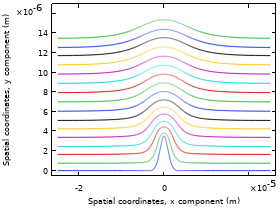
In einem Lithiummetall-Akku lagert sich während des Ladens Lithiummetall an der negativen Elektrode ab. Massentransport und Ohmsche Effekte im Elektrolyten führen zu einem beschleunigten Wachstum kleiner Vorsprünge auf der Metalloberfläche während des Ladevorgangs. Im schlimmsten Fall ... Mehr lesen
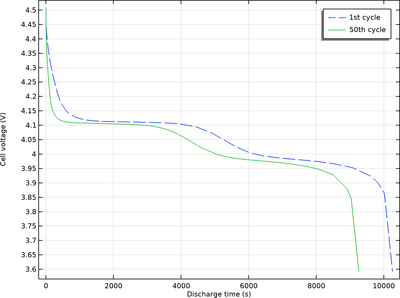
Some positive electrode materials are known to deteriorate in overcharged lithium-ion battery cells. Predominantly, manganese containing electrode materials such as LMO and NMC can loose capacity due to manganese dissolving from the materials at overcharge. This decomposition is a ... Mehr lesen

This example illustrates the principle of electrochemical polishing. The simplified 2D model geometry consists of two electrodes and an intermediate electrolyte domain The positive electrode has a protrusion, representing a surface defect. The purpose of the model is to examine how this ... Mehr lesen
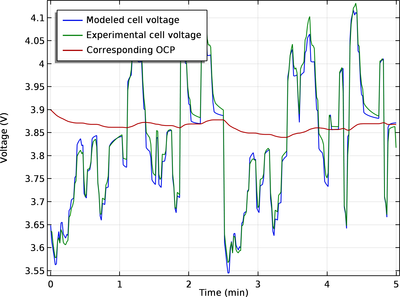
This tutorial uses a “black-box” approach to define a battery model based on a small set of lumped parameters, assuming no knowledge of the internal structure or design of the battery electrodes, or choice of materials. The input to the model is the battery capacity, the initial state ... Mehr lesen
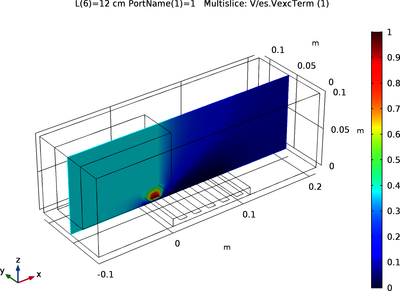
This tutorial model explains how to extract lumped matrices by means of the Stationary Source Sweep study. The capacitance matrix of a five-terminal system is used to infer the position of a metallic object similar to real-world capacitive position sensors. The example illustrates the ... Mehr lesen


