
Die Application Gallery bietet COMSOL Multiphysics® Tutorial- und Demo-App-Dateien, die für die Bereiche Elektromagnetik, Strukturmechanik, Akustik, Strömung, Wärmetransport und Chemie relevant sind. Sie können diese Beispiele als Ausgangspunkt für Ihre eigene Simulationsarbeit verwenden, indem Sie das Tutorial-Modell oder die Demo-App-Datei und die dazugehörigen Anleitungen herunterladen.
Suchen Sie über die Schnellsuche nach Tutorials und Apps, die für Ihr Fachgebiet relevant sind. Beachten Sie, dass viele der hier vorgestellten Beispiele auch über die Application Libraries zugänglich sind, die in die COMSOL Multiphysics® Software integriert und über das Menü File verfügbar sind.
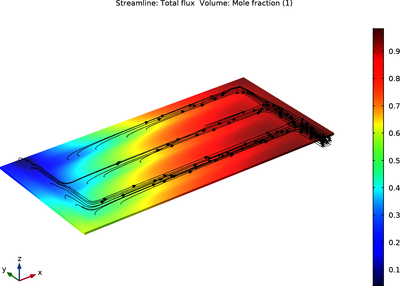
In diesem Beispiel wird eine Festoxid-Elektrolysezelle modelliert, in der Wasserdampf reduziert wird, um an der Kathode Wasserstoffgas zu bilden, und an der Anode Sauerstoffgas entsteht. Die Stromverteilung in der Zelle ist mit dem kathodenseitigen Stofftransport von Wasserstoff und ... Mehr lesen
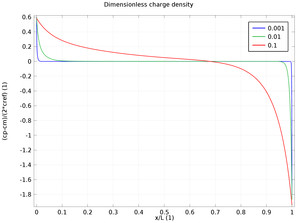
In the diffuse double layer and within the first few nanometers of an electrode surface, the assumption of electroneutrality is not valid due to charge separation. Typically, the diffuse double layer may be of interest when modeling very thin layers of electrolyte including those in ... Mehr lesen

This model defines a zero-gap alkaline water electrolyzer, where oxygen and hydrogen gas are evolved in porous gas diffusion nickel felt electrodes, placed adjacent to a porous separator (diaphragm). The geometry defines a unit cell of an electrolyzer stack, in turn comprising two full ... Mehr lesen
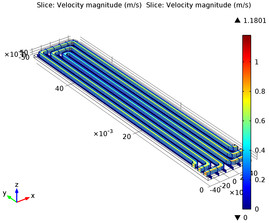
This example models the flow and mass transport in the channels and the gas diffusion layer (GDL) of a polymer electrolyte fuel cell. The cathode electrode reaction is modeled as a boundary condition, where the local current density depends on the overpotential and the local oxygen ... Mehr lesen
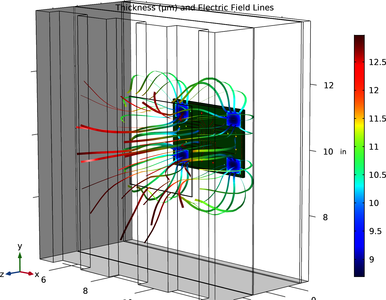
This example simulates electroplating of a printed circuit board (PCB) in 3D using the Secondary Current Distribution interface. In order to achieve thickness uniformity across the PCB, a dummy pattern is included in the design, along with an aperture in the electroplating bath. Mehr lesen

The GEC cell was introduced by NIST in order to provide a standardized platform for experimental and modeling studies of discharges in different laboratories. The plasma is sustained via inductive heating. The Reference Cell operates as an inductively-coupled plasma in this model. This ... Mehr lesen
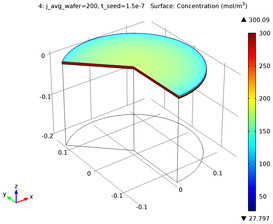
This example extends the analysis made in the model Electrodeposition on a Resistive Patterned Wafer by including the diffusion and convection of copper ions in the electrolyte. The coupled mass transport convection-diffusion effects are of interest in this type of reactor since they ... Mehr lesen
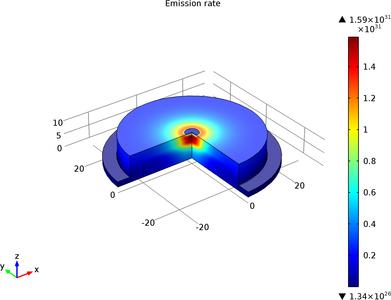
This model simulates an LED that emits in the infrared part of the electromagnetic spectrum. The device structure is made up of a single p-n junction formed by a layer of p-type doping near the top surface of an otherwise n-type wafer. This kind of device geometry is simple and cheap to ... Mehr lesen

This tutorial demonstrates how to use stationary polarization data to perform parameter estimation of a polymer electrolyte membrane fuel cell (PEMFC) model. The model, defining a 5-layer membrane electrode assembly (MEA) is two-dimensional and includes electronic and ionic charge ... Mehr lesen
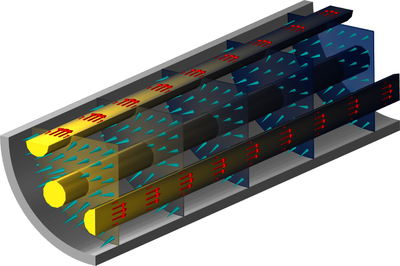
In Brennstoffzellen-Stromerzeugern wird der für den Zellstapel benötigte Wasserstoff in der Regel mit einem Dampfreformer erzeugt. Dieses Beispiel veranschaulicht die Modellierung eines Dampfreformers. Die chemische Reformierung findet in einem porösen Katalysatorbett statt, in dem ... Mehr lesen