
Die Application Gallery bietet COMSOL Multiphysics® Tutorial- und Demo-App-Dateien, die für die Bereiche Elektromagnetik, Strukturmechanik, Akustik, Strömung, Wärmetransport und Chemie relevant sind. Sie können diese Beispiele als Ausgangspunkt für Ihre eigene Simulationsarbeit verwenden, indem Sie das Tutorial-Modell oder die Demo-App-Datei und die dazugehörigen Anleitungen herunterladen.
Suchen Sie über die Schnellsuche nach Tutorials und Apps, die für Ihr Fachgebiet relevant sind. Beachten Sie, dass viele der hier vorgestellten Beispiele auch über die Application Libraries zugänglich sind, die in die COMSOL Multiphysics® Software integriert und über das Menü File verfügbar sind.

This 2D model demonstrates how to model a galvanic couple in which the corrosion of the anode causes a geometry deformation. The parameter data used is for an Magnesium Alloy (AE44) - mild steel couple in brine solution (salt water). Mehr lesen

This example models the heating inside an oven with the Single Phase Flow, Heat Transfer and Surface-to-Surface Radiation interfaces. It accounts for conductive, convective and radiative heat transfer. Two computation approaches are set up: A one-way nonisothermal flow (one-way NITF) ... Mehr lesen
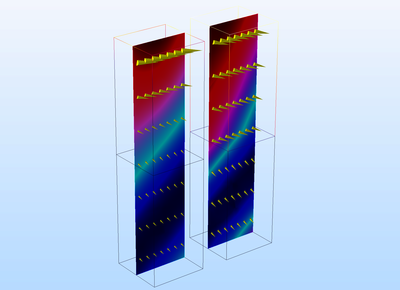
A plane electromagnetic wave propagating through free space is incident at an angle upon an infinite dielectric medium. This model computes the reflection and transmission coefficients and compares to the Fresnel equations. Mehr lesen
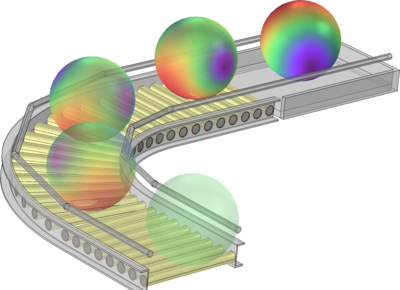
Roller conveyors are commonly used in warehouses, manufacturing units and baggage handling applications to transport objects from one place to other by gravity, power, or manually. A typical roller conveyor consists of an array of moving rollers arranged either in a straight or curved ... Mehr lesen
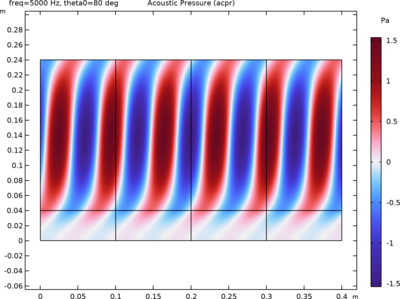
This is a 2D model of an anisotropic porous absorbing material. The absorption coefficient alpha are determined as functions of frequency for three different incidence angles. The example uses Periodic Floquet boundary conditions. The model uses two different methods for modeling the ... Mehr lesen
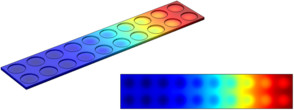
In small PEM fuel cell systems (in the sub-100 W range) no active devices for cooling or air transport are normally used. This is due to the desire to minimize parasitic power losses from pumps and fans, and to reduce the system complexity, size, and cost. The reactants at the cathode ... Mehr lesen
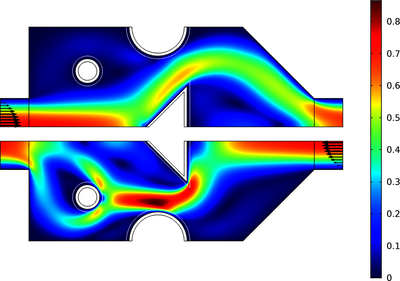
The topology optimized Tesla microvalve is used as inspiration for a parametrized geometry. The optimization of this geometry takes erosion and dilation of the geometry into account by optimizing over a parametric sweep. In this example the optimization is driven by the worst of the 3 ... Mehr lesen

This tutorial simulates the turn-off transient (reverse recovery) of a simple PIN diode with an inductive load, loosely based on the book "Fundamentals of Power Semiconductor Devices" by B. J. Baliga (p. 256, 2008 edition). Unlike the book, which assumes an initial constant current ramp ... Mehr lesen


