
Die Application Gallery bietet COMSOL Multiphysics® Tutorial- und Demo-App-Dateien, die für die Bereiche Elektromagnetik, Strukturmechanik, Akustik, Strömung, Wärmetransport und Chemie relevant sind. Sie können diese Beispiele als Ausgangspunkt für Ihre eigene Simulationsarbeit verwenden, indem Sie das Tutorial-Modell oder die Demo-App-Datei und die dazugehörigen Anleitungen herunterladen.
Suchen Sie über die Schnellsuche nach Tutorials und Apps, die für Ihr Fachgebiet relevant sind. Beachten Sie, dass viele der hier vorgestellten Beispiele auch über die Application Libraries zugänglich sind, die in die COMSOL Multiphysics® Software integriert und über das Menü File verfügbar sind.
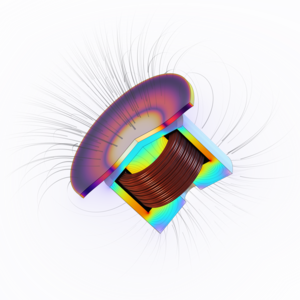
A magnetic diaphragm is a flexible, thin structure that interacts with magnetic fields to perform mechanical or sensing functions. When subjected to an external magnetic field, the diaphragm deforms due to magnetomechanical interactions, converting magnetic energy into mechanical ... Mehr lesen

Various boundary conditions are employed in the computation of homogenized properties for heterogeneous materials. The choice between periodic or homogeneous boundary conditions depends on whether the infinitesimal volume is modeled as a repeating unit cell (RUC) or a representative ... Mehr lesen
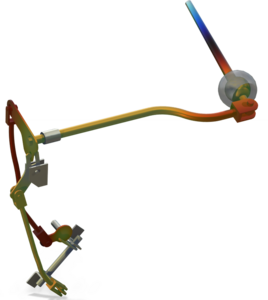
This model demonstrates the ability to simulate Multibody Dynamics in COMSOL. It comprises a multilink mechanism that is used in an antique automobile as a gearshift lever. It was created out of curiosity to find out how large forces are on the individual components. The model uses ... Mehr lesen

Gradient-based optimization is an efficient way of computing better values for many control variables. This example optimizes diameters of individual members in a truss structure such that the structure becomes stiffer without adding mass to the structure. The structure will be only be ... Mehr lesen
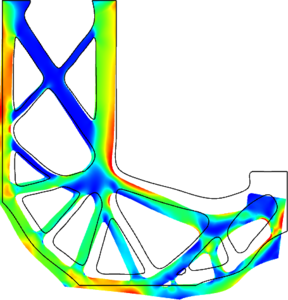
This model demonstrates 2D topology optimization for the problem of minimum mass subject to a compliance constraint and a stress constraint. The stress constraint is implemented with a P-norm global aggregation function. The stress input to this is interpolated differently than the Young ... Mehr lesen
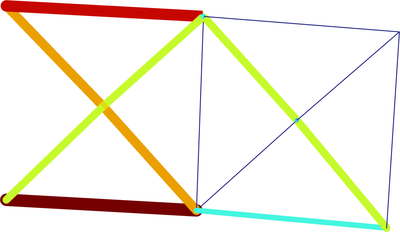
Find the optimal cross section areas of trusses in a structure given a prescribed set of limitations and a clear objective. The structure is made up of trusses which are elements that can only sustain axial forces. Mehr lesen

This model demonstrates one way of using equation-based modeling for generative design by using the powerful mathematical expression capabilities of COMSOL Multiphysics®. Mehr lesen
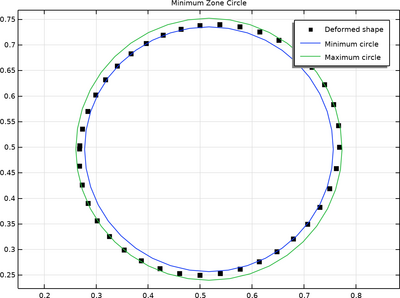
During manufacturing or in-service use, the geometric shape of structural components can deviate from their intended design. For example, a hole may lose its perfectly circular form, making it important to measure and control this deviation. The process of quantifying such deviations is ... Mehr lesen
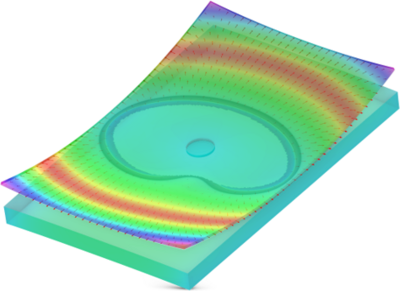
In direct bonding, particulate contamination at the interface can significantly reduce bonding quality. Even micron-scale particles may prevent local contact and lead to large interfacial voids. This model demonstrates a 3D simulation workflow for die-to-wafer (D2W) direct bonding. The ... Mehr lesen
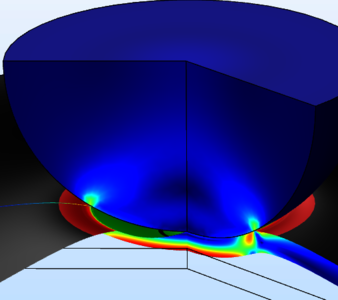
A steel ball is pressed down against a rubber membrane. When the contact pressure exceeds a certain value, the two parts start sticking together. When the ball is retracted, the membrane is pulled upwards in the bonded region. During the retraction, the bond is partially broken. This ... Mehr lesen


