
Die Application Gallery bietet COMSOL Multiphysics® Tutorial- und Demo-App-Dateien, die für die Bereiche Elektromagnetik, Strukturmechanik, Akustik, Strömung, Wärmetransport und Chemie relevant sind. Sie können diese Beispiele als Ausgangspunkt für Ihre eigene Simulationsarbeit verwenden, indem Sie das Tutorial-Modell oder die Demo-App-Datei und die dazugehörigen Anleitungen herunterladen.
Suchen Sie über die Schnellsuche nach Tutorials und Apps, die für Ihr Fachgebiet relevant sind. Beachten Sie, dass viele der hier vorgestellten Beispiele auch über die Application Libraries zugänglich sind, die in die COMSOL Multiphysics® Software integriert und über das Menü File verfügbar sind.

Dieses nicht-konventionelle Modell der Strömung in porösen Medien nutzt die schleichende (Stokes-) Strömung in den Zwischenräumen eines porösen Mediums. Das Modell stammt aus den von Arturo Keller, Maria Auset und Sanya Sirivithayapakorn von der University of California, Santa Barbara, ... Mehr lesen
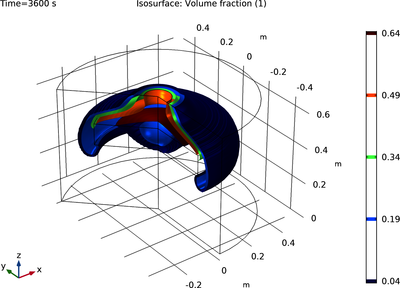
This example demonstrate two-phase flow in a porous medium which contains a low permeable lens. The heavier phase infiltrates the porous medium, so the low permeable lens is infiltrated only when a critical saturation at the outside is reached. Mehr lesen
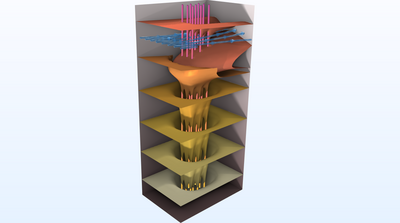
This model shows how to compute an array of borehole heat exchangers (BHEs) for shallow geothermal energy production. The BHEs are simplified as line heat sinks with a uniform heat extraction rate. The array is embedded into a layered subsurface model with groundwater flow in one of the ... Mehr lesen

This example models an oil reservoir with two horizontal wells. The reservoir contains two phases, water and oil. Oil is recovered by injecting water through the bottom well, so the oil production rate and the water-oil production ratio over time are computed. Mehr lesen
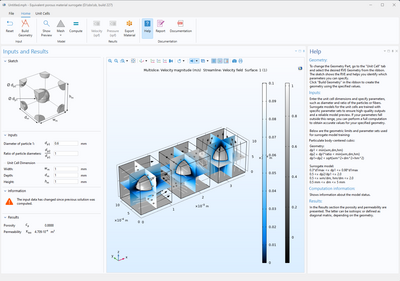
Porous materials are frequently represented through periodically arranged microstructures. To compute porous media flow, the macroscale permeability and porosity is used which can be calculated from the creeping flow results through the microscale unit cell. In this application, various ... Mehr lesen
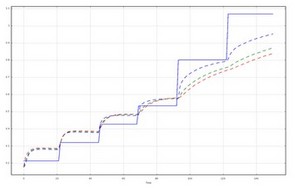
The first model describes the simultaneous flow of two immiscible fluids in porous media - here air displaces water in a multi-step inlet pressure experiment. We solve for the pressure and the degree saturation for the air and water within a representative volume and so track saturation ... Mehr lesen

This example shows how to set up a glacier flow model in principle, containing several important aspects of glacier modeling: The creation of the 2D geometry, the modeling of non-Newtonian flow, and the implementation of basal sliding. In this example, two different glacier types, a cold ... Mehr lesen
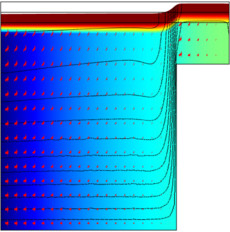
The Poroelasticity interface couples Darcy's law and solid mechanics to assess deformation of porous media that results from fluid withdrawals. The model builds on top of the Terzaghi Compaction example. Results from Terzaghi compaction and Biot poroelasticity analyses are compared to ... Mehr lesen

Aldicarb is a commercial pesticide, used on a variety of crops, including cotton, fruits, potatoes, and beans. This arises in the possibility that the general population may be exposed to aldicarb through the ingestion of contaminated water and foods. This example looks at the ... Mehr lesen

Density variations can initiate flow even in a still fluid. In earth systems, density variations can arise from naturally occurring salts, subsurface temperature changes, or migrating pollution. This buoyant or density-driven flow factors into fluid movement in salt-lake systems, saline ... Mehr lesen


