光热响应智能材料的弯曲和滚动的有限元模拟
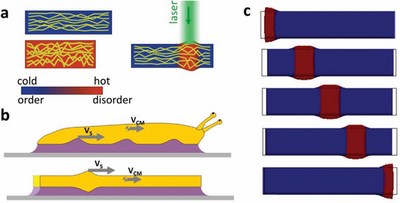
Photothermally responsive liquid-crystal-based materials and hydrogels offer promising routes to remotely controlled soft actuators for adaptive structures, soft robotics, and biomedical devices. Their design requires predictive models that connect light absorption and heat transfer with material-specific deformation mechanisms. This work proposes a finite element framework in COMSOL Multiphysics to investigate the coupled optical, thermal, and mechanical behaviour of these materials under light irradiation.
Light absorption is represented as a spatially dependent heat source using a Beer–Lambert formulation, while transient heat conduction and environmental heat losses determine the evolving temperature field. For liquid crystal elastomers, thermally induced changes in orientational order are coupled to anisotropic spontaneous deformation through a temperature-dependent constitutive description. For thermoresponsive hydrogels, actuation is described through coupled solvent transport and finite-strain mechanics, incorporating temperature-dependent swelling and deswelling. The framework combines COMSOL’s heat-transfer and solid-mechanics interfaces with transport equations and user-defined constitutive relations.
The proposed analysis examines how irradiation intensity, absorption depth, director orientation, sample geometry, and thermal boundary conditions influence displacement, actuation timescale, and stress distribution. Particular attention is given to through-thickness temperature gradients and their contribution to bending and spatially nonuniform deformation. A validation strategy based on analytical limiting cases and experimental temperature–displacement measurements is outlined. By linking distinct actuation mechanisms within a common computational framework, this approach provides a basis for comparing photothermal material systems and guiding the design of programmable soft devices.
The talk also studies flexural vibration. Flexural vibration can arise solely from rolling, representing a mode of excitation that has received little systematic investigation. Because the resulting motion is planar and induced by rolling, its analysis integrates structural dynamics, flexural vibration, and rolling-contact mechanics. The term “rolling-induced flexural vibration” is introduced to describe this phenomenon. It is relevant not only to the general theory of structural vibration but also to emerging rolling mechanisms, particularly compliant or “soft” rolling robots. The proposed framework may therefore be applied to stimulus-responsive soft robots that roll on a surface or between contacting surfaces.
This study formulates the rolling-induced flexural vibration problem and investigates it using three-dimensional contact finite element analysis (FEA) in COMSOL Multiphysics. The Solid Mechanics interface is employed to model a cylinder rolling in contact with a rough, flat surface. The three-dimensional contact-FEA results are compared with predictions from a rolling-beam model and with available exact analytical solutions. COMSOL is particularly suitable for this comparison because its mathematical formulations and model definitions are transparent and readily adjustable.
Different contact formulations available in COMSOL are also assessed. The results indicate that the penalty method may lose accuracy as the cylinder aspect ratio increases. In such cases, the augmented Lagrangian method provides improved accuracy, although at a considerably higher computational cost. Overall, the results validate the rolling-beam formulation and clarify the respective accuracy and efficiency of reduced-order and three-dimensional approaches for modeling rolling-induced flexural vibration.
Keywords: Photothermal actuation; liquid crystal elastomers; thermoresponsive hydrogels; finite element modelling; coupled multiphysics; contact mechanics