
3D RVE Simulation for Permittivitty tuning in SiO2-Core/C-shell Epoxy Nanocomposites
Creating polymers with tunable permittivitt and loss tangent simultaneously requires precise control of the conductive filler microstructure through process optimization. Carbon coated SiO2 (C@SiO2) nanoparticles in an epoxy matrix represent a suitable system for this challenge. Permittivitty enhancements will be driven by the Maxwell-Wagner-Sillar interfacial polarization induced by the interface between the conductive C-shell and the insulating SiO2 core. This interfacial polarization should contribute to the tunability of the relaxation spectrum. Here, the formation of long-range conductive networks cause massive dielectrics losses. Surface treatment of C@SiO2 particles can be done to tackle this critical complication of nanoparticle agglomeration. Without surface treatment, the C@SiO2:NPs cluster within the epoxy matrix, affecting the dispersion of the conductive shells, lowering the percolation threshold, and altering the e" and tan d in an unpredictable manner. this work addresses that challenge through a combined experimental and computational approach using COMSOL Multiphysics.
Two distinct sample types will be studied here: One with untreated particles allowing natural agglomeration, and one functionalized with GPTMS silane coupling agents to promote uniform dispersion. The material properties of the carbon shell, SiO2 core and the epoxy matrix will use the estimated values directly from the COMSOL Muyltiphysics database and will be adjusted as the physical composites are fabricated and measured, closing the gap between the simulation and experimental data.
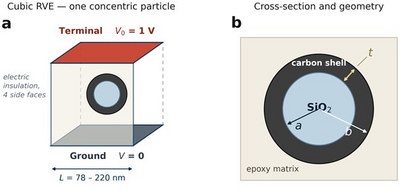
The model uses the AC/DC module with the electric currents physics interface for calculations, depending on Frequency domain structures to study the effective complex permittivity and loss tangent as a function of frequency for different arrangements of the coated and uncoated nanoparticles. 3D RVE are used to represent the nanocomposites with necessary periodic boundary conditions applied to negate spurious edge effects and accurately replicate the macroscopic bulk behavior. Livelink for MATLAB is used to generate the PVE geometries, allowing reproducible control over nanoparticle dispersions from well-dispersed to agglomerated, along with variation of particle size and carbon coating thickness.
This study will provide the framework needed to establish structure-property-performance correlations between dielectric properties of the epoxy matric with respect to nanofiller dispersion and characteristics (coating thickness and particle size). The COMSOL simulations will provide a predictive design tool for engineering C@SiO2 epoxy nanocomposites with targeted permittivity and loss characteristics.
Herunterladen
- SiO2C_MWS_poster -final.pdf - 0.51MB
- SiO2C_MWS_paper-final.pdf - 2.19MB


