DesignSpace AI: Mapping Every Solution to Your Multiphysics Design Problem
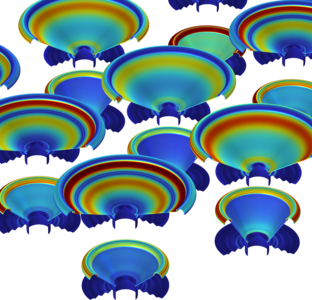
Engineering design is fundamentally an inverse problem. A designer knows what performance they need, and they want to know what combinations of design parameters will get them there. Conventional optimization tools answer a narrower version of this question: given constraints and an objective, what is the single best design? This formulation is powerful but limiting, because it collapses what is often a rich, multimodal solution space down to one point estimate, hiding the dozens or hundreds of equally valid alternatives that might better suit downstream constraints around cost, manufacturability, or material availability. To address this gap, TRACE Simulation designed and built DesignSpace AI, a cutting-edge generative machine learning tool purpose-built for inverse engineering design. Rather than returning a single optimum, DesignSpace AI returns the entire population of design parameter combinations that satisfy a user's performance targets, effectively mapping the full feasible design manifold for any multiphysics system. When coupled with COMSOL Multiphysics, the workflow becomes especially powerful: COMSOL provides the high-fidelity physics engine that generates training data and validates AI-suggested designs, while DesignSpace AI provides the inverse design capability that lets engineers explore the full space of viable solutions in seconds. Together, the two tools transform engineering design from a sequential optimization exercise into a guided exploration of the trade-space. A key enabler of this coupled workflow is COMSOL's flexible set of integration pathways for external code. Custom subroutines and tools like DesignSpace AI can communicate with COMSOL through the native Java API, Python integrations, or LiveLink for MATLAB. This means that an external AI or optimization engine can launch parametric sweeps, retrieve simulation outputs, push candidate designs back into COMSOL for high-fidelity validation, and orchestrate iterative loops between AI exploration and physics verification, all without manual intervention. The demonstration case for this work was loudspeaker design and acoustic analysis, an ideal multiphysics testbed in which structural, electromagnetic, and acoustic behaviors all interact. COMSOL ran a parametric sweep across design variables such as cone diameter, material properties, and enclosure volume, with coupled Acoustics, Structural Mechanics, and AC/DC Modules predicting sensitivity, low-frequency cutoff, frequency response flatness, and total harmonic distortion for each configuration. The resulting dataset was exported and used to train DesignSpace AI. Once trained, the tool answered inverse queries, setting design constraints and performance requires, returning numerous viable parameter combinations in seconds. Selected candidates could then pushed back to COMSOL via the Java API for high-fidelity validation, closing the loop between rapid AI exploration and rigorous multiphysics verification. While loudspeakers served as the demonstration case, the methodology is domain-agnostic. The same workflow can be applied to antenna arrays, heat exchangers, battery cells, MEMS resonators, biomedical implants, aerodynamic surfaces, and any other multiphysics system where designers must navigate a complex trade-space under multiple competing constraints.