
Electric Field Computation in Defibrillation Studies on Realistic Cardiac Geometries
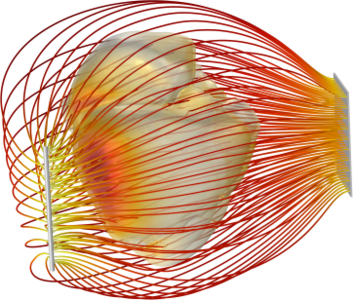
Computational studies of cardiac defibrillation currently utilize homogenous electric field distributions [1-3]. However, inside the heart, the electric field depends strongly on the underlying cardiac geometry and the configuration of the defibrillation electrodes. Computing this field on an anatomically realistic geometry, however, is non-trivial. The aim of this work is to demonstrate a pragmatic workflow in which COMSOL Multiphysics is used to import a realistic four-chamber heart mesh, place realistic electrode patterns, compute the resulting electric field and current density, and export the field for further processing.
We use a heart geometry from a human CT-scan, which is publicly available [4]. A central challenge is that COMSOL does not support the native case mesh format in which these geometries are distributed. We therefore use ParaView to convert the mesh into the STL surface format, which COMSOL can import directly. The CAD Import Module is used to repair the imported geometry so that a valid heart mesh domain is obtained. Via the Mesh Part functionality this domain can be used alongside the geometric modelling of the defibrillation electrodes in the Geometry node as well as for the Physics definition in the Electric Currents interface of the AC/DC Module for the computation of the electric potential, field, and current distribution throughout the cardiac tissue.
The workflow successfully reproduces the anatomically detailed heart geometry as a usable simulation domain and yields smooth, physically plausible electric field and current density distributions for the chosen electrode configurations. Our approach of using COMSOL Multiphysics lowers the barrier to incorporating anatomically realistic geometries and electrode patterns into defibrillation research.
Herunterladen
- 17791_final_poster.pdf - 31.08MB
- 17791_final_paper.pdf - 4.17MB


