
Modelling the H2S adsorption from biogas with Comsol Multiphysics®
Biogas represents one of the most promising renewable sources for energy production, in which the livestock manure gives several desirable advantages for the anaerobic biodigestion process [1]. However, desulfurization is necessary to prevent corrosive mechanisms and protect the system from hydrogen sulphide (H2S), an undesirable gas which is also toxic and flammable. Among the different conventional technical used to purify the biogas, adsorption is a preferable solution due to its cost-effectiveness, easy of implementation and ability to operate at ambient temperature and pressure [2]. The adsorption of H2S onto carbon activated is one of the most used methods [3], which is generally set up and investigated in a fixed-bed column, where it is also possible to measure the break-through curves and adsorption capacity of adsorbents.
In this work we develop a two-dimensional, axisymmetric, time-dependent model of H2S adsorption in bed fixed-column. The physical model consists of a porous bed of packed spherical particles, through which a mixture of methane, carbon dioxide and hydrogen sulphide enters. In COMSOL Multiphysics® we describe the gas flow by the Brinkman Equations interface for porous media, whereas the Transport of Diluted Species in Porous Catalyst interface accounts for the evolution of the species by diffusion, convection and mass transfer mechanisms [4]. For the adsorption process, the mass transfer in the fluid inside the porous matrix is treated by means of a Linear Driving Force (LDF) model. On the other hand, the adsorption of H2S onto the porous particles is modeled using the nonlinear isotherm both of Langmuir and Freundlich. The coupling between the physics of Brinkman Equations and Transport of Diluted Species in Porous Catalyst is added by using the COMSOL Multiphysics® Reacting Flow, Diluted Species Coupling feature to synchronize their relationship. Some parameters of the model representing the kinetics of the adsorption process were selected in the literature from the work of Aguilera and Gutiérrez [5], whereas other values were estimated by empirical correlations. The numerical solution of the differential equations of the model is obtained by dividing the study in two steps. The first stationary study step solves for the pressure and velocity and the second time-dependent study computes the mass transfer magnitudes with the velocity field from the first study.
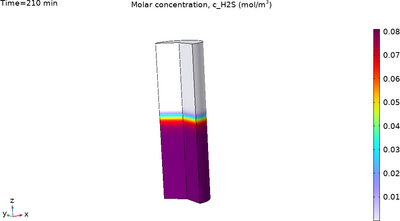
The computational results describe satisfactorily the adsorption process of H2S from biogas, showing the influence of the main operational parameters. The evolution of the mass transfer zone in the porous bed fixed-column is also well characterized, showing its progression along the length of the reactor. The breakthrough curves simulated by the model indicate favourable kinetics and bed efficiencies.
Herunterladen
- 17802_final_poster.pdf - 0.35MB
- 17802_final_paper.pdf - 0.8MB


