
Multi-Physics Simulation Based Development of LPBF Components for High Temperature Furnaces
High temperature vacuum furnaces typically operate at power levels of several hundred kilowatts and are generally equipped with rapid cooling systems to achieve the cooling rates required for heat treatment processes. However, the rear gas outlet and gas inlet nozzles, commonly in state-of-the art furnaces implemented as simple openings with recessed shielding, represent a dominant source of radiative heat losses, contributing approximately one third of the total energy losses of a furnace and adversely affecting the temperature homogeneity in the load volume.
To develop the next generation of energy efficient refractory metal hot zones for high temperature vacuum furnaces at Plansee SE, multi-physics simulations were employed to design and optimize thin walled, gas permeable structures that reduce thermal radiation losses while maintaining low flow resistance. For the rear gas outlet, a so called FlowBox consisting of an array of thin-walled cosine shaped rectangular channels was developed. This concept combines multiple effective shielding layers for thermal radiation with a low resistance for the gas flow. The corresponding concept was applied to the gas inlet nozzles, featuring an array of cosine channels arranged circumferentially with increasing amplitude in radial direction.
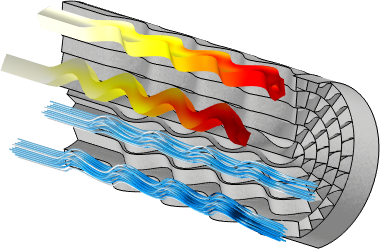
Prior to manufacturing, thermal and fluid dynamic Comsol models were employed to evaluate the shielding effectiveness and flow resistance of the developed structures for the rear gas outlet and gas inlet nozzles. A stationary thermal model of the entire high temperature vacuum furnace was applied to analyse the potential of a FlowBox for an improved temperature homogeneity (Figure 1). For this purpose, the Heat Transfer in Solids, Heat Transfer in Shells and Surface-to-Surface Radiation interfaces of the Heat Transfer Module were used to model the temperature distribution throughout the furnace components at a prescribed operating temperature. Stationary thermal sub models of the rear gas outlet and gas inlet nozzles were used to estimate the energy saving potential of the new gas system concept compared to a state-of-the-art gas system (Figure 2). In addition, for those sub models gas flow and pressure decay, as a measure for cooling efficiency, were evaluated based on stationary and time-dependent fluid dynamic calculations (Figure 3). For these analyses, the Turbulent Flow and Heat Transfer in Fluids interfaces of the Heat Transfer Module were applied. The modelling results predicted a significant potential for energy savings at an improved temperature homogeneity without a loss of cooling efficiency for the newly developed gas system concept.
Based on these results, the developed structures were subsequently fabricated using laser powder bed fusion (LPBF) of molybdenum (Figure 4), integrated into and tested in a dedicated furnace at Plansee SE to evaluate power consumption, temperature homogeneity and cooling efficiency. The results confirmed the predictions of the multi-physical modelling. Power savings of 13 % and a significantly improved temperature homogeneity as well as an improved cooling efficiency could be demonstrated for the test furnace equipped with the new concept of a LPBF gas system developed based on multi-physics simulations.
Herunterladen
- 19031_final_poster.pdf - 0.69MB
- 19031_final_paper.pdf - 1.24MB


