Seeing What Sensors Cannot: An ICME Framework for AFSD Aluminum Hole Repair
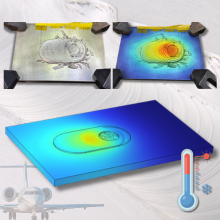
Additive Friction Stir Deposition (AFSD) is a solid-state additive manufacturing process capable of producing structural repairs with mechanical properties approaching those of wrought material, making it particularly attractive for restoring damaged aerospace components such as those containing fastener holes, corrosion pits, or localized cracks. Predictive modeling of AFSD is challenging because the simulation must simultaneously capture transient frictional heat generation at the rotating tool-substrate interface, conjugate heat transfer through the substrate and deposited layers, and the time-dependent addition of feedstock material as the defect cavity is progressively filled. Without explicit representation of the evolving deposition geometry, predicted thermal histories cannot accurately reflect the heat accumulation that governs microstructural evolution and post-repair mechanical performance. A high-fidelity AFSD process model was developed in COMSOL Multiphysics using the Heat Transfer Module, with the material activation feature employed to dynamically introduce deposited material into the simulation domain as the tool traversed, plasticized, and extruded feedstock into through-hole defects in AA7050-T7451 substrates. Pre-defined layers of repair material were incrementally activated to replicate physical hole filling, enabling direct visualization of fill progression alongside the evolving thermal field. Virtual probes were placed throughout the build geometry to extract time-resolved temperature data at any point of interest. Heat generation at the tool-material interface used a torque-based expression, Q=2πωμτ, leveraging directly measured spindle torque from the MELD B8 system. The model was calibrated against thermocouple measurements from a 3-inch linear track build and validated against independent 6-inch and 2-inch builds to confirm scalability. During AFSD, the most important regions to understand, beneath the toolhead, inside the cavity as it fills, and within freshly deposited material, are precisely where thermocouples cannot survive or physically fit. By placing virtual probes at the top, middle, and bottom of the repair centerline, the simulation served as a thermometer in places no real sensor could go, predicting peak temperatures as high as 434 °C, well above what surface-mounted thermocouples recorded. These previously hidden time-temperature histories were then handed off to Thermo-Calc, where they drove predictions of how the aluminum's strengthening precipitates dissolve, coarsen, and re-form during the repair, ultimately enabling estimates of post-repair strength. As shown in the recently published work by Jabbar et al. [1], showcasing the work by TRACE Simulation (a division of Triton Systems), this coupled approach revealed that tool strategy and hole geometry directly govern whether the repaired material retains its strength or suffers from precipitate over-aging. This work demonstrates that COMSOL can serve as the central engine for predictive AFSD repair design, bridging the gap between processing decisions and microstructural outcomes, and laying the groundwork for qualifying solid-state repair as a trusted technology for extending the service life of critical aerospace structures.