
Thermo-Poroelastic Modeling of Channelized Melt Fingers in Crystal-Rich Magma Reservoirs
The generation of eruptible magma from long-lived, crystal-rich mush reservoirs is a central problem in volcanology. Many volcanoes erupt frequently from storage regions where the interstitial melt fraction sits below the eruptibility threshold of roughly 50 vol%, which implies that physical processes must reorganize the mush into localized zones of mobile melt. We investigate how the injection of hotter melt into a cooler, partially crystalline reservoir drives this reorganization, with particular focus on whether melt becomes channelized into connected, finger-like pathways capable of feeding ascent.
We address this question with a fully coupled three-dimensional model built in COMSOL Multiphysics. The model couples four physics interfaces. Solid Mechanics represents an elastic host rock together with a poroelastic mush reservoir, Darcy's Law governs pressure-driven melt flow through the evolving crystal framework, Heat Transfer in Porous Media carries both conductive and advective heat with a latent-heat term tied to melting and crystallization, and the Poroelasticity Multiphysics coupling links pore melt pressure to deformation and porosity. These draw on the Structural Mechanics, Subsurface Flow, and Heat Transfer modules. A spherical reservoir of 1 km radius is embedded at 7 km depth within a laterally extensive elastic domain, discretized with an adaptively refined tetrahedral mesh.
Material properties evolve dynamically with local temperature, pressure, and volatile content. Using the composition of Soufrière Hills Volcano, Montserrat, as a reference, we compute melt fraction from rhyolite-MELTS, volatile solubility, and degassing paths from VESIcal, and melt viscosity from the Giordano et al. (2008) model, with permeability following a Kozeny-Carman relation with the melt fraction. These fields are used as input in the simulation through interpolation functions, so viscosity, density, compressibility, and permeability update continuously as melt fraction, pressure, and temperature changes.
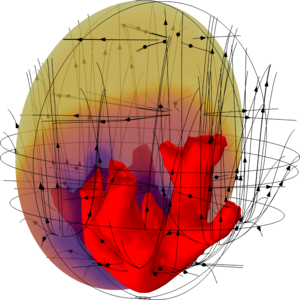
Across reservoir temperatures of 750 to 900°C and injection temperatures of 900 to 1300°C, the thermal contrast controls the style of the magma rejuvenation. Small contrasts produce compact, rounded melt pockets that stay disconnected. Large contrasts trigger a thermo-poroelastic feedback in which local heating raises porosity and lowers viscosity, permeability increases, and melt focuses in connected channelization. This feedback channelizes melt into branching, vertically connected fingers. Eruptible melt fractions reach 12 to 14% of the reservoir in cold, high-flux cases, while injection duration sets whether peak eruptible volume is high and short-lived or lower and more sustained. The resultant surface deformation remains within ranges consistent with geodetic observations.
The results show that hot melt injection can build connected, eruptible melt pathways within an otherwise locked mush without requiring extreme surface uplift, and that reservoir and recharge temperature shape both the internal melt structure and the deformation signal recorded at the surface. This offers a physically grounded framework for interpreting unrest at crystal-rich volcanic systems.
Herunterladen
- 22 - Rami Alshembari.pdf - 1.76MB


