
Sehen Sie, wie die Multiphysik-Simulation in verschiedenen Branchen eingesetzt wird
Multiphysik-Modellierung und -Simulation treiben Innovationen in Industrie und Wissenschaft voran – wie die zahlreichen Anwendungsbeispiele zeigen, die jedes Jahr in den Fachbeiträgen und Postern von Ingenieuren, Forschern und Wissenschaftlern auf der COMSOL Conference vorgestellt werden. Lassen Sie sich von den unten aufgeführten aktuellen Beiträgen inspirieren oder nutzen Sie die Schnellsuche, um eine bestimmte Präsentation zu finden oder nach Anwendungsbereich oder Konferenzjahr/-ort zu filtern.
Sehen Sie sich die Kollektion für die COMSOL Conference 2024 an

Sedimentation is a challenging two-phase problem to model and simulate. Many applications in the industry use sedimentation for separation. For example treatment of wastewater often carried out in settling basins. Different types of the sedimentation process include independent and zone ... Mehr lesen
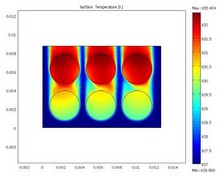
Most reactor designs are based on pseudo homogeneous models. This paper studies the COMSOL simulation of a packed bed reactor using a 2-D heterogeneous model. The case considered was a packed reactor with spherical catalyst for oxidation of o-xylene in air to phthalic anhydride. Large ... Mehr lesen

Steam Reforming of Ethanol using a Catalytic Wall Reactor (CWR) was successfully studied using COMSOL Multiphysics. A mathematical model was used to describe the reactor performance in terms of the main variables and dimensionless groups. Simulations showed that at specified conditions ... Mehr lesen
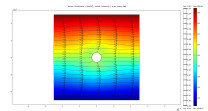
The paper presents and compares two models for simulating magneto-hydrodynamic flow of RedOx electrolyte in a conduit patterned with circular pillars. The first model solves the coupled Nernst-Planck and Navier-Stokes equations subjected to Butler-Volmer electrode kinetics and provides ... Mehr lesen
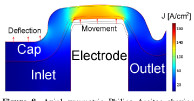
Redmer van Tijum studied Applied Physics at the University of Groningen. In 2006, he received his PhD title on ‘Interface and surface roughness of polymer metal laminates’ in the field of Material Science at the University of Groningen. After that he became research and development ... Mehr lesen

Chlorine reactor is used to dry molten LiCl-KCl eutectic salt before it is put to use in electrorefining operation. Molten salt electrorefining is a pyrochemical method of separation of heavy elements from spent metallic nuclear fuel. It is a high-temperature process which uses molten ... Mehr lesen

Dielectrophoresis (or DEP) has been exploited for various micro and nano fluidics applications like patterning, sorting and separation. However, there are several commonly neglected issues in quantifying DEP forces. Such negligence could potentially lead to wrong DEP force predictions ... Mehr lesen

Some NASA efforts are focused on improving current systems that utilize fixed beds of sorbent pellets by evaluating structured sorbents, seeking more robust pelletized sorbents, and examining alternate bed configurations to improve system efficiency and reliability. For the bulk ... Mehr lesen
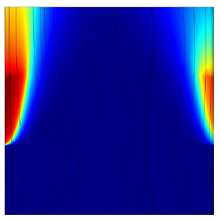
The dependency of electrochemical processes performances on mass transfer is well-known. Electrolyte flow in the vicinity of electrodes surface can enhance reactions due to increased mass transfer. This flow can be generated by the production of a gaseous phase, leading to a natural ... Mehr lesen

An inactive Demonstration facility for the integrated pyroprocess, named High temperature Electrorefining (HTER) facility is in developing stage. This facility is equipped with several types of pyroprocess equipment such as electro-refiner, salt and cadmium distillation equipment, ... Mehr lesen


