
General Atomics Designs Helicon Antenna for Tokamak with Simulation
Humberto Torreblanca, General Atomics, USA
Built by engineers at General Atomics, the DIII-D tokamak needs to achieve temperatures that are 10 times hotter than the core of the Sun to achieve nuclear fusion. To accomplish this, a novel heating system using a helicon antenna that can inject 1 megawatt of RF power is being designed and built. Humberto Torreblanca, the DIII-D tokamak chief operator, and his team are using multiphysics simulation to model all aspects of the design, such as the magnetic field distribution inside and outside the tokamak vessel as well as the electric field distribution and RF losses of the helicon antenna.
Suggested Stories
Making Predictions in Additive Manufacturing with Simulation Apps
Engineers at the Industrial Technology Research Institute (ITRI) can predict the performance of laser powder bed ...
Investigating Intrabody Communication for Leadless Cardiac Pacemakers
MicroPort CRM used numerical simulation to optimize leadless cardiac pacemaker (LCP) designs and how they communicate ...
Optimizing the Performance of Complex Building Façades
Engineers at Newtecnic specialize in complex building design, working with bold and fluid architectural shapes. To ...
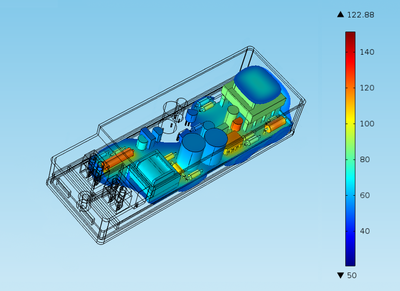
Keeping LEDs Cool Gets More Manageable Through Simulation
Light-emitting diodes (LEDs) offer many benefits over incandescent lighting, such as long life spans and high luminous ...


