
Konica Minolta Uses Simulation to Study and Optimize OLED Devices
Leiming Wang, Konica Minolta Laboratory, USA
As the demand for lightweight and flexible electronics continues to increase, so does the demand for lightweight and flexible light sources. Organic LEDs (OLEDs) have garnered tremendous interest because of their inherent elasticity, but suffer from a lack of brightness and efficiency. Researchers at Konica Minolta are working to alleviate these limitations and minimize light lost in their OLED designs. Using the COMSOL Multiphysics® software, they simulated the electromagnetic field and light emission distribution for a variety of nanostructured cathode geometries, determined the optimal configuration, and were able to cut light losses in half.
Suggested Stories
Optimizing a CVD Process for a High-Performance Tungsten Material
Researchers at Forschungszentrum Jülich GmbH, Institute for Energy and Climate Research, and Max Planck Institute for ...
The Sound of Perfection Thanks to the Modeling of Acoustic Metasurfaces
At the École Polytechnique Fédérale de Lausanne (EPFL), engineers have designed an acoustic metasurface that could be ...
Man-Made Stars: Evaluating Structural Integrity in High-Performance Nuclear Fusion Machines for Power Generation
For over 50 years, power generation through nuclear fusion has been the focus of international research efforts to ...
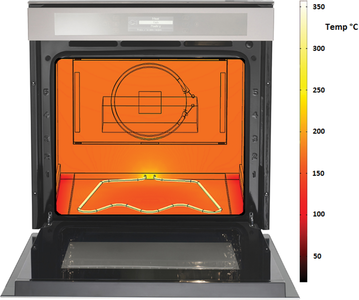
Simulation Turns Up the Heat and Energy Efficiency at Whirlpool Corporation
Engineers working on a joint research project between Whirlpool Corporation and the European initiative GREENKITCHEN ...


