
KAPL Analyzes CO2 Foil Thrust Bearing Characteristics with Simulation
Treevor Munroe
Knolls Atomic Power Laboratory, Niskayuna, NY
Knolls Atomic Power Laboratory (KAPL) is a research and development facility supporting the United States Naval Nuclear Propulsion Program. KAPL recently collaborated with Bettis Atomic Power Laboratory to test a supercritical carbon dioxide (S-CO2) Brayton power cycle system.
The system was designed to operate at high speed and high gas pressure, which means the turbine shaft bearings must withstand a wide range of radial and axial loads. The thrust bearings used to constrain the axial forces, however, showed extensive wear at certain speeds.
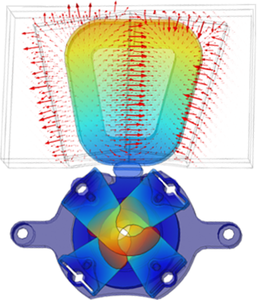
Using COMSOL Multiphysics, KAPL was able to analyze the structural mechanics, fluid mechanics, and heat transfer of the Brayton power cycle system to better understand the operation and deterioration of the thrust bearings. This allowed them to optimize geometry and to improve bearing performance.
Suggested Stories
Researching a New Fuel for the HFIR: Advancements at ORNL Require Multiphysics Simulation to Support Safety and Reliability
In response to the increasing awareness of the risks associated with the proliferation of nuclear materials, the ...
The Unseen Wonders of Radiant Heating, Cooling, and Snowmelting
Viega designs residential and commercial radiant heating and cooling systems. By building simulation applications and ...
Keeping Cool: SRON Develops Thermal Calibration System for Deep-Space Telescope
Deep-space telescopes require ultrasensitive detectors and calibration to pick up weak far-infrared signals. The SpicA ...
Entwicklung von Elektrofahrzeugen mit einem Doppelbatterieansatz
Die IAV hat einen Ansatz entwickelt, bei dem Natrium-Ionen- und Festkörper-Lithium-Eisenphosphat-Batterietechnologien ...


