
Monika Weber
Yale University
New Haven, CT
Professor Mark Reed and his team at Yale University are using COMSOL Multiphysics to develop a MEMS-based solution for detecting bacteria in blood. Called the α Screen, it will provide analyses speedily, accurately, and cost-effectively. Such a device would greatly help the food industry in improving meat quality and reducing the risk for infections. Current methods take too long for most food industries to use, as they need to deliver and sell food fresh, while newer alternatives are too expensive for routine use.
As a member of this leading nanotechnology group, Monika Weber used COMSOL Multiphysics to simulate aScreen and optimize its performance. This included modeling the microfluidics of the device and using particle tracing to track the potential routes taken by bacteria within the device.
With her model and presentation of the aScreen, Weber won the 2011 NASA Tech Briefs Create the Future Design Contest.
Suggested Stories
Prototyping Antennas for Mobile Recording of TV Sports Events with Simulation
Researchers at Radiotelevisione Italiana (RAI) are optimizing circularly polarized antenna designs for recording live ...
Getting Touchy-Feely with Touchscreen Design
We rely on capacitive touchscreens whenever we interact with a smartphone, MP3 device, or car video screen. ...
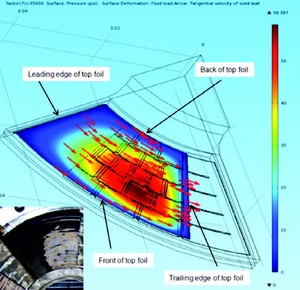
Multiphysics Analysis of CO2 Foil Thrust Bearing Characteristics
Knolls Atomic Power Laboratory (KAPL) is a research and development facility supporting the United States Naval ...
Defying Convention to Achieve Faster Signal and Simulation Speeds
As the demand grows for faster electronic devices in smaller packages, we need to develop optimized high-speed ...


