
Using Simulation to Rapidly and Precisely Model Nanoresonators
J. Yang, M. Perrin, P. Lalanne
CNRS, France
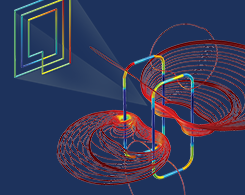
Nanoresonators, or optical nanoantennas, manage the concentration, radiation, and absorption of light at the nanometer scale and show stunning promise for future improvements to technology, such as sensors, computers, and other electronics. However, the ways that these devices scatter light and interact with their surrounding environment are not well understood, nor are the electromagnetic properties of the complex metal shapes that comprise them. Numerical approaches to calculating the resonance modes and excitations in nanoresonators have historically been cumbersome and error-prone.
Now, researchers and engineers at Institut d’Optique d’Aquitaine (Paris, France) are using COMSOL Multiphysics simulations to rapidly and precisely determine physical properties, calculate the resonance modes, and analyze the electromagnetic fields and scattering that occur due to excitation. They expect that their new approach to modeling these nanoresonators will lead to advancements in the development and use of nanoelectromechanical devices (NEMS) for a wide range of applications such as photovoltaics, spectroscopy, and improved electronic systems.
Suggested Stories
Simulations-Apps erleichtern die Entwicklung von Elektromotoren
Die Ingenieure von Volkswagen Kassel entwickeln und vertreiben Simulations-Apps, mit denen sich die Festigkeit von ...
Defying Convention to Achieve Faster Signal and Simulation Speeds
As the demand grows for faster electronic devices in smaller packages, we need to develop optimized high-speed ...
Helicon Antenna Supports Nuclear Fusion
Built by engineers at General Atomics, the DIII-D tokamak needs to achieve temperatures that are 10 times hotter than ...
Der zunehmende Einsatz von Simulation in der biomedizinischen Industrie
Von Implantaten und Stents bis hin zu MRT und Rückenmarkstimulation – die numerische Modellierung ist für die ...


