
F. Curtis, J.D. Freels
Oak Ridge National Lab, TN, USA
In response to the increasing awareness of the risks associated with the proliferation of nuclear materials, the Global Threat Reduction initiative has called for research reactors currently using highly enriched uranium (HEU) fuel to be converted to low-enriched uranium (LEU) fuel. The High Flux Isotope Reactor (HFIR), located at Oak Ridge National Laboratory (ORNL), is one such reactor that uses HEU fuel.
Using multiphysics simulation, ORNL engineers are conducting researching and working toward a new design for the HFIR that will preserve the reactor's performance, minimize negative effects on operation efficiency, and ensure reactor safety once the reactor’s fuel has been converted. This process requires that highly accurate multiphysics analyses be conducted into the fluid-structure interaction (FSI) of the reactor’s fuel plates and that an understanding of how the new density of the LEU fuel will impact reactor performance is achieved. ORNL researchers developed a model of the fuel plate deflections in COMSOL Multiphysics that they validated against representative tests using core configurations similar to the HFIR. The model will be used to test new design possibilities and eventually help facilitate the reactor's conversion to LEU fuel.
Suggested Stories
Keynote: Modeling Low-Temperature Superconducting Devices in COMSOL Multiphysics®
In this keynote talk from the COMSOL Conference 2024 Boston, Anil Erol of Northrop Grumman shares how his team uses ...
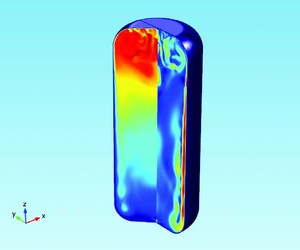
Modeling Helps Improve Safety in the Production of Teflon
BAM German Federal Institute for Materials Research & Testing in Berlin promotes industrial development by ...
Generatives Design für die Entwicklung von Wasserstoff-Brennstoffzellen
Das Toyota Research Institute of North America (TRINA) arbeitet an wasserstoffbetriebenen Fahrzeugen. Das TRINA-Team ...
Simulations-Apps treiben die Produktentwicklung in der Automobilindustrie voran
Mahindra & Mahindra Limited (M&M) beschleunigt seinen Produktentwicklungszyklus für Automobilkomponenten und ...


