
Engineers in France Use Simulation to Develop New Roof Runners
Simon Chiartano,
Terres Réfractaires du Boulonnais (TRB), France
To contain splashes and provide protection at plants where metal is fabricated, blast furnace runners need a roof made of cast iron and concrete. Terres Réfractaires Du Boulonnais, a manufacturing company in France, has hundreds of blast furnaces with a short functional lifespan, so engineers need to design roof runners as economically as possible while maintaining overall safety. During the metal production process, molten metal reaches temperatures near 1500 °C, making it impossible to take temperature measurements, and control the processes in this way.
TRB turned to simulation with COMSOL Multiphysics and the Heat Transfer Module to determine temperature in the roof runners. Simulation results provided engineers with great insight so that they could create new roof runners that are lighter, easier to manufacture, and safer to maneuver.
Suggested Stories
Keynote: Electromagnetic-Based Hyperthermia Therapy for Treatment of Brain Cancer
This keynote talk from the COMSOL Conference 2024 Boston explores how Dr. Dario Rodrigues from the University of ...
WiTricity Leverages Magnetic Resonance for Flexible Wireless Charging
Engineers at WiTricity have developed a flexible wireless charging setup that relies on magnetic resonance and can be ...
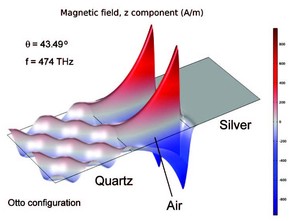
Surface Plasmon Resonance
Surface Plasmon Resonance (SPR) is created by surface plasmons, coherent electron oscillations existing between any ...
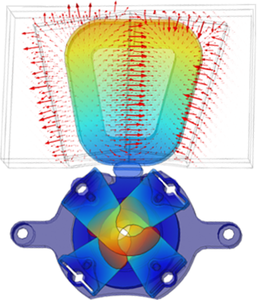
Keeping Cool: SRON Develops Thermal Calibration System for Deep-Space Telescope
Deep-space telescopes require ultrasensitive detectors and calibration to pick up weak far-infrared signals. The SpicA ...


