
Die Application Gallery bietet COMSOL Multiphysics® Tutorial- und Demo-App-Dateien, die für die Bereiche Elektromagnetik, Strukturmechanik, Akustik, Strömung, Wärmetransport und Chemie relevant sind. Sie können diese Beispiele als Ausgangspunkt für Ihre eigene Simulationsarbeit verwenden, indem Sie das Tutorial-Modell oder die Demo-App-Datei und die dazugehörigen Anleitungen herunterladen.
Suchen Sie über die Schnellsuche nach Tutorials und Apps, die für Ihr Fachgebiet relevant sind. Beachten Sie, dass viele der hier vorgestellten Beispiele auch über die Application Libraries zugänglich sind, die in die COMSOL Multiphysics® Software integriert und über das Menü File verfügbar sind.

Dieses Beispiel besteht aus einer 2D-Analyse der Ausbreitungsmoden in der Kammer eines Schalldämpfers. In diesem Fall wird davon ausgegangen, dass die Wände des Schalldämpfers aus einem linear elastischen Material bestehen, und ihr Einfluss auf die Moden, die sich durch den Querschnitt ... Mehr lesen

This tutorial model shows how to import a 3D scanned geometry of a human head and torso and compute the head related transfer function (HRTF). The scan is imported as a .stl file and converted into a COMSOL geometry. The HRTF is computed using the reciprocity principle, locating the ... Mehr lesen

Dieses Tutorial-Modell zeigt einen virtuellen Testaufbau eines Konferenzlautsprechers. Das Lautsprechersystem besteht aus einem Lautsprecher sowie drei Mikrofonen. Das Modell veranschaulicht die Schallabstrahlung des Lautsprechers, die Rückkopplung sowie die Fähigkeit des Systems, ... Mehr lesen
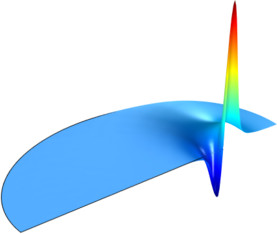
An ellipse with sound-hard walls has the interesting property that an acoustic signal emanating from one of the foci refocuses at the other focal point b/c seconds later, where b (in meters) is the major axis length and c (m/s) is the speed of sound. This model involves a Gaussian ... Mehr lesen

Model of the sound radiation from a circular duct with uniform flow. The convected acoustic problem is described using the linearized potential flow equations, solved in the frequency domain. The acoustic inlet is treated including higher order modes using the Port boundary condition and ... Mehr lesen

In this tutorial the acoustic behavior of a duct or waveguide with a right-angled bend is analyzed. The model uses port boundary conditions at the inlet and outlet. The ports can capture and treat non-plane propagating modes in waveguides, extending the analysis above the first cutoff ... Mehr lesen
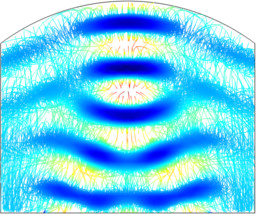
An ultrasonic standing wave levitator, also called acoustic levitator, is a device used for levitating fluid and solid particles in an acoustic field. The standing acoustic waves exert an acoustic radiation force on the particles. The force is a second order effect and stems from a ... Mehr lesen
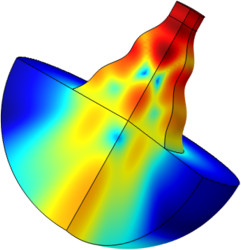
A plane-wave mode feeds an axisymmetric horn radiating from an infinite baffle toward an open half space. The radius of the waveguide attached to the horn throat is assumed to be fixed, as well as the depth of the horn and the size of the horn mouth attached to the baffle. By varying the ... Mehr lesen

The vibration modes of a thin or thick circular disc are well known, and it is possible to compute the corresponding eigenfrequencies to arbitrary precision from a series solution. The same is true for the acoustic modes of an air-filled cylinder with perfectly rigid walls. A more ... Mehr lesen
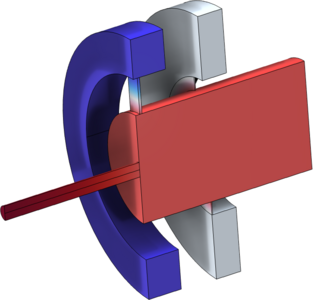
This model computes the input impedance/admittance to an acoustic system in the frequency domain. The system here represents a typical measurement setup used for testing hearing aids and includes domains with thermoviscous boundary layer losses. The input admittance, computed in the ... Mehr lesen


