
Die Application Gallery bietet COMSOL Multiphysics® Tutorial- und Demo-App-Dateien, die für die Bereiche Elektromagnetik, Strukturmechanik, Akustik, Strömung, Wärmetransport und Chemie relevant sind. Sie können diese Beispiele als Ausgangspunkt für Ihre eigene Simulationsarbeit verwenden, indem Sie das Tutorial-Modell oder die Demo-App-Datei und die dazugehörigen Anleitungen herunterladen.
Suchen Sie über die Schnellsuche nach Tutorials und Apps, die für Ihr Fachgebiet relevant sind. Beachten Sie, dass viele der hier vorgestellten Beispiele auch über die Application Libraries zugänglich sind, die in die COMSOL Multiphysics® Software integriert und über das Menü File verfügbar sind.
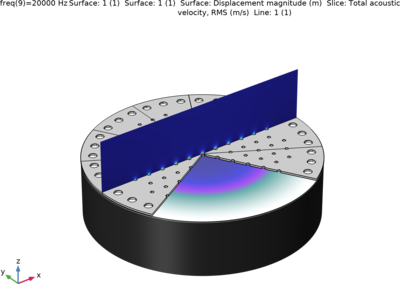
This is a model of a MEMS microphone solved in the frequency domain including the DC prestress effects. The model is set up using the Electromechanics multiphysics interface, Thermoviscous Acoustics, and Pressure Acoustics. The microphone consists of a perforated plate and a prestressed ... Mehr lesen
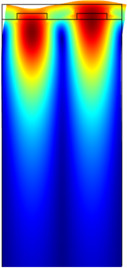
Eine akustische Oberflächenwelle (surface acoustic wave, SAW) ist eine akustische Welle, die sich entlang der Oberfläche eines festen Materials ausbreitet. Ihre Amplitude nimmt in der Tiefe des Materials schnell, oft exponentiell, ab. SAWs werden in vielen Arten von elektronischen ... Mehr lesen
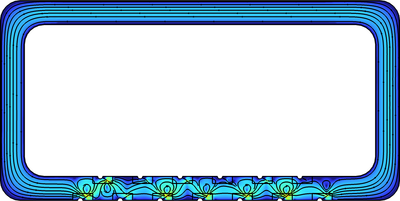
This tutorial uses a 2D model of an acoustically driven microfluidic pump. The acoustic microfluidic pump is driven by acoustic streaming originating from sharp edges in the microfluidic channel. It drives a flow around a closed microfluidic channel loop. The acoustic field is modeled ... Mehr lesen
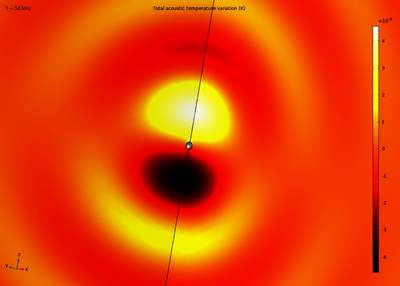
This tutorial simulates a small vibrating hemispherical particle in water. The particle has a radius of 1 mm and is oscillating in the axial direction at a frequency of 50 kHz. The vibrations induce acoustic waves in the fluid. The example demonstrates how to set up a thermoviscous ... Mehr lesen
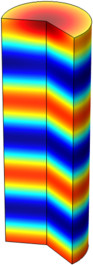
In this model, sound created by a vibrating piston radiates through a baffled pipe. The impedance is measured and then used in an impedance boundary condition that replaces the surrounding air domain. This technique can be employed to reduce solution time and memory usage for large ... Mehr lesen
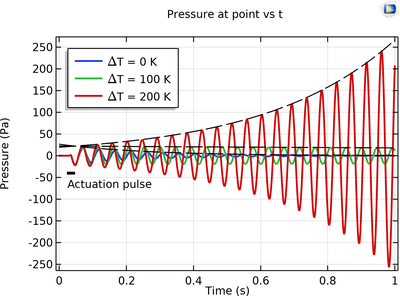
Dies ist ein Modell eines einfachen thermoakustischen Motors, der einen thermischen Stack zur Umwandlung von Wärmeenergie in akustische Energie enthält. Das Modell wird mit zwei Ansätzen aufgebaut: 1) Mit einem linearen Störungsansatz (akustisch) wird die Fluidbewegung mit dem Interface ... Mehr lesen
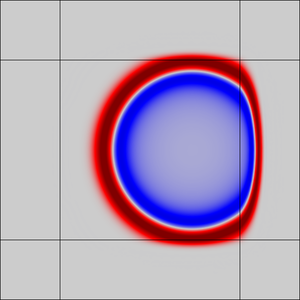
This tutorial simulates a standard test and benchmark model for nonreflecting conditions and sponge layers for linearized Euler-like systems. It involves the propagation of a transient Gaussian pulse in a 2D uniform flow. The Convected Wave Equation, Time Explicit interface solves the ... Mehr lesen
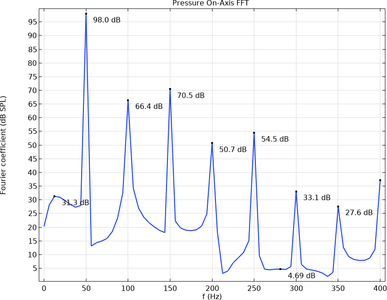
Dieses Modell zeigt, wie man das nichtlineare (Großsignal-) Verhalten bestimmter Lumped-Komponenten in eine vereinfachte Lautsprecheranalyse einbeziehen kann. Das mechanische und elektrische System wird mit Hilfe einer elektrischen Ersatzschaltung modelliert. Die Großsignal ... Mehr lesen
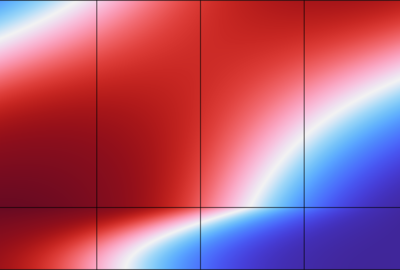
This tutorial investigates the acoustic properties of a porous layer made of glass wool. The porous material has transverse isotropic properties and is modeled with the full anisotropic poroelastic material model. Mehr lesen
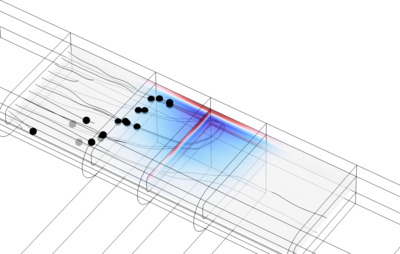
Ein 3D-Modell einer akustischen Falle in einer Glaskapillare mit einem Bias-Flow durch die Kapillare. Die Akustik wird durch ein oszillierendes elektrisches Potential über einen piezoelektrischen Wandler angeregt, das mechanische Schwingungen im Festkörper und ein akustisches Druckfeld ... Mehr lesen


