
Die Application Gallery bietet COMSOL Multiphysics® Tutorial- und Demo-App-Dateien, die für die Bereiche Elektromagnetik, Strukturmechanik, Akustik, Strömung, Wärmetransport und Chemie relevant sind. Sie können diese Beispiele als Ausgangspunkt für Ihre eigene Simulationsarbeit verwenden, indem Sie das Tutorial-Modell oder die Demo-App-Datei und die dazugehörigen Anleitungen herunterladen.
Suchen Sie über die Schnellsuche nach Tutorials und Apps, die für Ihr Fachgebiet relevant sind. Beachten Sie, dass viele der hier vorgestellten Beispiele auch über die Application Libraries zugänglich sind, die in die COMSOL Multiphysics® Software integriert und über das Menü File verfügbar sind.
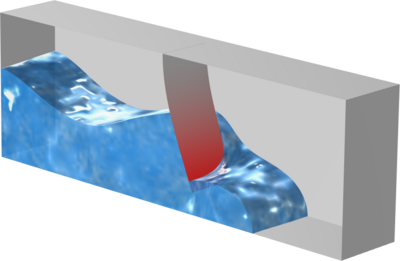
Das folgende Beispiel demonstriert Techniken zur Modellierung einer Fluid-Struktur-Interaktion mit zwei Fluidphasen in COMSOL Multiphysics. Es veranschaulicht, wie ein schwereres Fluid mithilfe der Methode Arbitrary Lagrangian-Eulerian (ALE) zusammen mit der Anwendung von Two-Phase Flow, ... Mehr lesen

Cyclones are used in a variety of applications ranging from the mining industry to vacuum cleaners. The flow in a cyclone is characterized by a very strong swirl, which makes it difficult to simulate. In this tutorial example, the v2-f turbulence model is used to simulate the flow in a ... Mehr lesen

This example is an established benchmark case for the shallow water equations that models a 1/400 scaled laboratory experiment of the tsunami runup in Monai Valley in Japan. The experiment was made at the Central Research Institute for Electric Power Industry (CRIEIPI) in Abiko, Japan, ... Mehr lesen
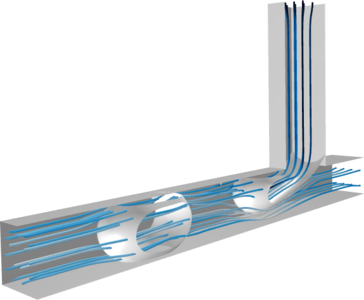
Emulsionen bestehen aus kleinen Flüssigkeitströpfchen, die in eine nicht mit ihnen mischbare Flüssigkeit eingetaucht sind, und kommen häufig bei der Herstellung von Lebensmitteln, Kosmetika, Feinchemikalien und pharmazeutischen Produkten vor. Die Qualität des Produkts ist in der Regel ... Mehr lesen
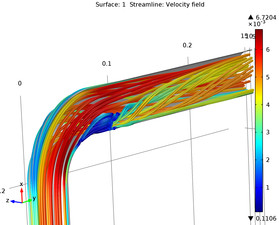
Dieses Beispiel modelliert die Strömung in einer 90-Grad-Rohrbiegung. Die Strömung wird mit dem k-omega Turbulenzmodell simuliert. Das Ergebnis wird mit technischen Korrelationen verglichen. Mehr lesen

This is a conceptual model illustrating how to couple fluid-structure interaction, heat transfer, and thermal expansion. A bimetallic strip in an air channel is heated so that it bends. After some time, an airflow with an inlet temperature which varies in time is introduced. As a ... Mehr lesen

Dieses Beispiel simuliert die turbulente Strömung um einen Sportwagen, der mit einer Geschwindigkeit von 180 km/h fährt, mithilfe von Large-Eddy-Simulationen (LES). Mehr lesen
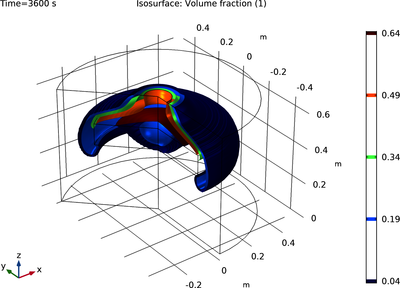
This example demonstrate two-phase flow in a porous medium which contains a low permeable lens. The heavier phase infiltrates the porous medium, so the low permeable lens is infiltrated only when a critical saturation at the outside is reached. Mehr lesen


