
Die Application Gallery bietet COMSOL Multiphysics® Tutorial- und Demo-App-Dateien, die für die Bereiche Elektromagnetik, Strukturmechanik, Akustik, Strömung, Wärmetransport und Chemie relevant sind. Sie können diese Beispiele als Ausgangspunkt für Ihre eigene Simulationsarbeit verwenden, indem Sie das Tutorial-Modell oder die Demo-App-Datei und die dazugehörigen Anleitungen herunterladen.
Suchen Sie über die Schnellsuche nach Tutorials und Apps, die für Ihr Fachgebiet relevant sind. Beachten Sie, dass viele der hier vorgestellten Beispiele auch über die Application Libraries zugänglich sind, die in die COMSOL Multiphysics® Software integriert und über das Menü File verfügbar sind.
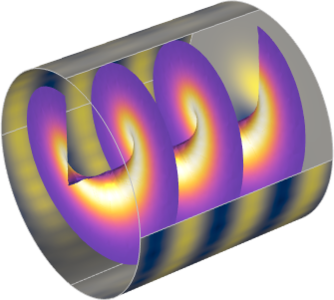
This model simulates Gaussian to Laguerre Gaussian beam shaping with the Beam Envelopes interface, the unidirectional wave formulation. The input beam is a focusing Gaussian beam with a topological spiral phase. It is known that this phase mask converts a Gaussian beam to a donut ... Mehr lesen

This model extracts spice parameters for a silicon p-n junction diode. The spice parameters are used to create a lumped-element equivalent circuit model of a half-wave rectifier that is compared to a full device level simulation. In this example, a device model is made by connecting a 2D ... Mehr lesen
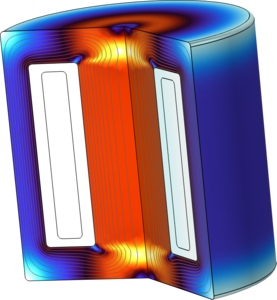
If an inductor's magnetic material is nonlinear, then the inductance depends on the current passing through it. This model consists of an inductor with a nonlinear magnetic core, where the small-signal inductance is simulated as a function of current. The model also investigates how ... Mehr lesen
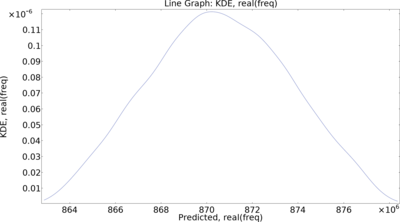
Uncertainty quantification is used to study the effect of manufacturing variation on the performance of a 2D solidly mounted resonator (2D SMR). This tutorial shows how the resonant frequency is affected by thickness variations of the piezoelectric layer and the Bragg reflector layers. ... Mehr lesen

This model shows how shape optimization can be used design the coils of an ICP reactor to obtain plasma uniformity. The reactor in study is a planar ICP with the coils distributed along the radial direction. The Optimization study step is used to find the best coil placement so that the ... Mehr lesen
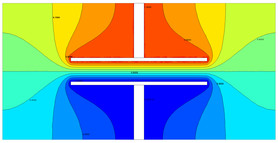
Ein Kondensator ist in seiner einfachsten Form ein elektrisches Gerät mit zwei Anschlüssen, das elektrische Energie speichert, wenn eine Spannungsdifferenz zwischen den Anschlüssen angelegt wird. Die gespeicherte elektrische Energie ist proportional zum Quadrat der angelegten Spannung ... Mehr lesen
In this tutorial model, the far-field radiation pattern of a dipole antenna is computed in a 2D axisymmetric model component. Then, in a separate 3D model component, a ray is released using the far-field radiation pattern to initialize the ray's intensity, polarization, and phase. Mehr lesen

This model shows how to model an electrolyte-gated organic field-effect transistor based on a general drift–diffusion model. The model uses the Transport of Charge Carriers interface and the Electrostatics interface. The transistor characteristics are visualized. Formation of the EDLs in ... Mehr lesen


