
Die Application Gallery bietet COMSOL Multiphysics® Tutorial- und Demo-App-Dateien, die für die Bereiche Elektromagnetik, Strukturmechanik, Akustik, Strömung, Wärmetransport und Chemie relevant sind. Sie können diese Beispiele als Ausgangspunkt für Ihre eigene Simulationsarbeit verwenden, indem Sie das Tutorial-Modell oder die Demo-App-Datei und die dazugehörigen Anleitungen herunterladen.
Suchen Sie über die Schnellsuche nach Tutorials und Apps, die für Ihr Fachgebiet relevant sind. Beachten Sie, dass viele der hier vorgestellten Beispiele auch über die Application Libraries zugänglich sind, die in die COMSOL Multiphysics® Software integriert und über das Menü File verfügbar sind.
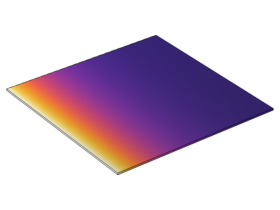
This example models heat transfer in a thin rectangular metal plate. Because the plate’s thickness is only 1/100 of its length and width, you can simulate the process using a 2D approximation. The plate has a fixed temperature at one end and is isolated at the other. A surrounding liquid ... Mehr lesen
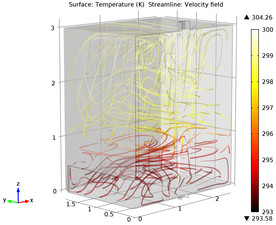
In general, there are two classes of ventilation: mixing ventilation and displacement ventilation. In displacement ventilation, air enters a room at the floor level and displaces warmer air to achieve the desired temperature. Heating sources in the room can include running electronic ... Mehr lesen
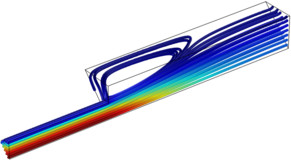
This tutorial model solves the incompressible Navier-Stokes equations in a backstep geometry using the Laminar Flow interface. A characteristic feature of fluid flow in geometries of this kind is the recirculation region that forms where the flow exits the narrow inlet region. The model ... Mehr lesen
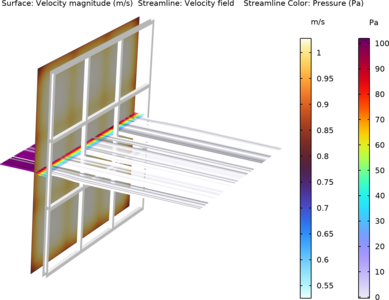
This example demonstrates simulation of a turbulent flow in a geometry with an air filter. Porous material of the filter induces an abrupt pressure drop and drastic increase of turbulence level inside the filter. Mehr lesen

A 2D model of a steel bar is used to simulate oil quenching from an austenitic state. Both diffusive and displacive phase transformations are used, and the phase composition is computed in the radial direction of the bar. Mehr lesen

This example reproduces parts of the study of Ref. 1 on the thermal contact resistance at the interface between a heat sink and an electronic package. Eight cooling fins equip the cylindrical heat sink and contact is made at the radial boundaries of the package. The efficiency of the ... Mehr lesen
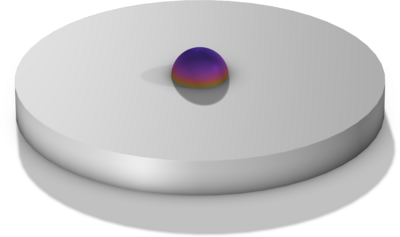
Die Verdunstung von Tröpfchen ist im Alltag allgegenwärtig und spielt bei vielen industriellen Prozessen wie dem Tintenstrahldruck, der Reinigung oder Beschichtung von Oberflächen und dem Wärmetransport durch Phasenwechsel eine wesentliche Rolle. In diesem Modell verdunstet ein ... Mehr lesen
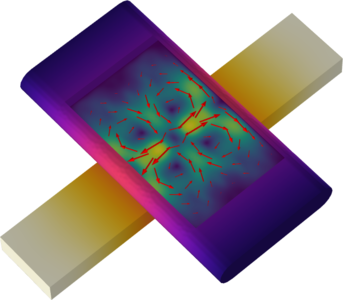
Dies ist ein 3D-Modell einer akustischen Falle in einer Glaskapillare, die durch einen piezoelektrischen Wandler betrieben wird. Das System wird durch ein oszillierendes elektrisches Potential über den piezoelektrischen Wandler angetrieben, das mechanische Schwingungen im Festkörper und ... Mehr lesen

This model represents a test case of a flow in an elastic tube which is present in several applications. This specific case models viscoelastic flow and represents steady flow in a channel in which part of the upper wall is replaced by an elastic plate subjected to an external pressure. ... Mehr lesen
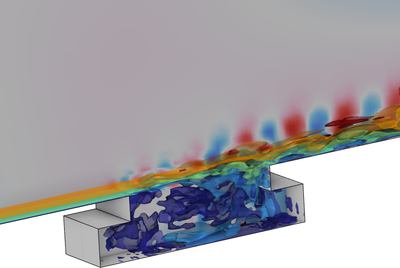
Die Strömung über einen Hohlraum und das dabei entstehende tonale Geräusch ist eine typische Quelle für Strömungsgeräusche in Rohrleitungssystemen, die Ventile und andere Hohlräume aufweisen. Dieses Tutorial-Modell stellt einen einfachen Fall von Strömungsgeräuschen in Hohlräumen eines ... Mehr lesen


