
Die Application Gallery bietet COMSOL Multiphysics® Tutorial- und Demo-App-Dateien, die für die Bereiche Elektromagnetik, Strukturmechanik, Akustik, Strömung, Wärmetransport und Chemie relevant sind. Sie können diese Beispiele als Ausgangspunkt für Ihre eigene Simulationsarbeit verwenden, indem Sie das Tutorial-Modell oder die Demo-App-Datei und die dazugehörigen Anleitungen herunterladen.
Suchen Sie über die Schnellsuche nach Tutorials und Apps, die für Ihr Fachgebiet relevant sind. Beachten Sie, dass viele der hier vorgestellten Beispiele auch über die Application Libraries zugänglich sind, die in die COMSOL Multiphysics® Software integriert und über das Menü File verfügbar sind.
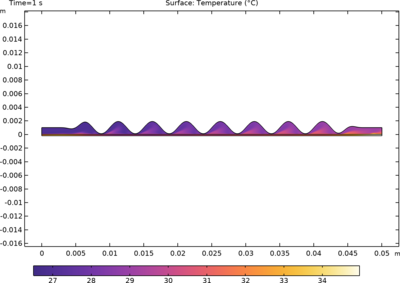
The heat exchanger in this tutorial model contains a dynamic wall with an oscillating wave shape. The deformation induces mixing in the fluid and reduces the formation of thermal boundary layers. Hence, it increases heat transfer between the walls and the fluid. In addition, the wave ... Mehr lesen
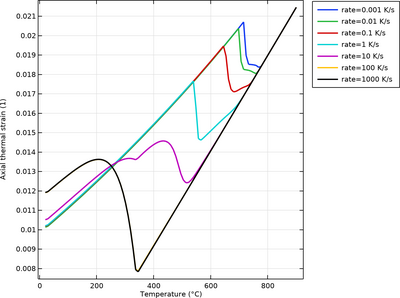
In this example, phase transformation data and phase material properties are imported from JMatPro, and used to compute CCT curves. Dilatometry curves (axial thermal strain) are computed across a range of cooling rates. Mehr lesen
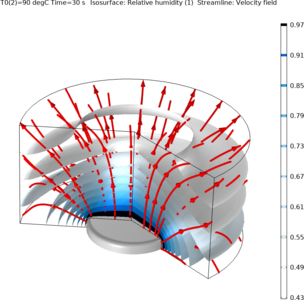
This tutorial model demonstrates the use of the Moisture Flow coupling node to account for the Stefan flow in moist air, over an evaporation surface. The effects on the velocity field and vapor concentration are presented with different ambient temperature conditions. Mehr lesen
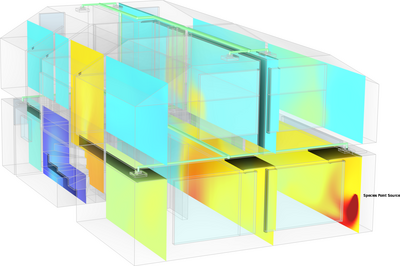
This model of a two-story house can be used to examine a contaminant leak and the subsequent contaminant dispersion that occurs due to convection and diffusion. Airflow and recirculation within the home are dependent on vent placement, and flow velocity may also vary at each vent. ... Mehr lesen
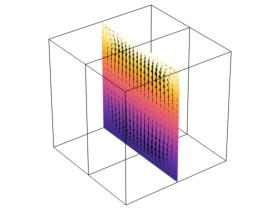
This example studies the stationary state of free convection in a cavity filled with water and bounded by two vertical plates. To generate the buoyancy flow, the plates are heated at different temperatures, bringing the regime close to the transition between laminar and turbulent. To ... Mehr lesen
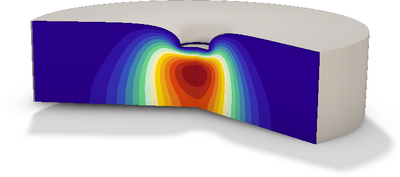
This example demonstrates how to use the Poroelasticity multiphysics coupling between the Solid Mechanics and Darcy's Law interfaces to model linear biphasic poroviscoelastic behavior of soft biological tissues. The implementation is verified using two numerical benchmarks from the ... Mehr lesen
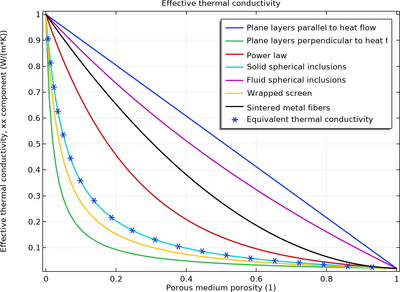
This tutorial presents the averaging models available within the Heat Transfer in Porous Media interface, used to compute the effective thermal conductivity, when the local thermal equilibrium assumption is made. The models are compared for porosities ranging from 0 to 1, and for a ... Mehr lesen
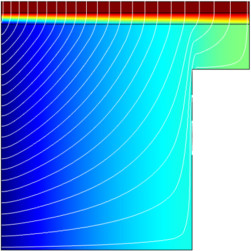
Fluids that move through pore spaces in an aquifer or reservoir can shield the porous medium from stress because they bear part of the load from, for instance, overlying rocks, sediments, fluids, and buildings. Withdrawing fluids from the pore space increases the stress the solids bear, ... Mehr lesen

This example uses the thermal expansion of a laminated composite shell model to demonstrate the use of the feature Thermal Contact, Interface, applied on interfaces between layers in a laminated composite shell. The first study is computed neglecting this additional thermal resistance in ... Mehr lesen

This example models a split-and-recombine mixer channel in which a tracer fluid is introduced and mixed by multilamination. Diffusion is removed from the model using an extremely low diffusion coefficient so that any numerical diffusion can be studied in the lamination interfaces. The ... Mehr lesen


