
Die Application Gallery bietet COMSOL Multiphysics® Tutorial- und Demo-App-Dateien, die für die Bereiche Elektromagnetik, Strukturmechanik, Akustik, Strömung, Wärmetransport und Chemie relevant sind. Sie können diese Beispiele als Ausgangspunkt für Ihre eigene Simulationsarbeit verwenden, indem Sie das Tutorial-Modell oder die Demo-App-Datei und die dazugehörigen Anleitungen herunterladen.
Suchen Sie über die Schnellsuche nach Tutorials und Apps, die für Ihr Fachgebiet relevant sind. Beachten Sie, dass viele der hier vorgestellten Beispiele auch über die Application Libraries zugänglich sind, die in die COMSOL Multiphysics® Software integriert und über das Menü File verfügbar sind.
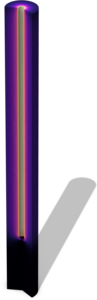
Fluence rate is a key parameter for ultraviolet (UV) water purifier. It describes the amount of radiation that pathogens absorb and is then directly related to the disinfection level of the purifier. The aim of this example is to demonstrate the fluence rate calculation with the ... Mehr lesen
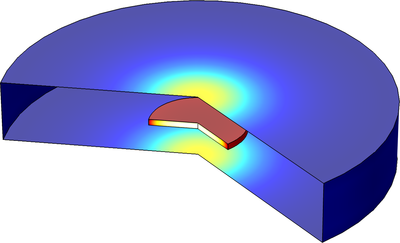
The flash method is widely used for measuring the thermal conductivity of a thin sample material that is about the size of a coin. The sample material is submitted to a laser pulse on one of its faces. In turn, the opposite face is heated up by around 1 K. As the pulse is uniform and ... Mehr lesen
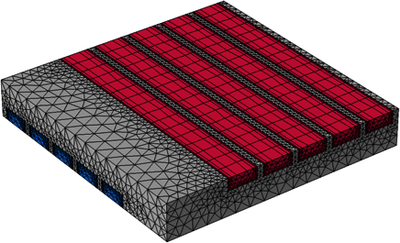
You can use assembly meshing to reduce the number of mesh elements in your model, which is especially useful for conjugate heat transfer simulation in cases where the fluid domains can be handled with swept mesh. These models demonstrate how to use form assembly and discontinuous meshes ... Mehr lesen

The purpose of this model is to introduce the specular reflection in Surface-to-Surface Radiation using the ray-shooting algorithm. Different parameters are available to the user to yield better accuracy in the results when using the ray-shooting algorithm. The model is a standard ... Mehr lesen

When radiation occurs across a very narrow gap this is often well-approximated as radiation between infinite parallel plates. This model considers three aluminum plates separated by narrow air gaps. The model compares the classical approach, based on the Surface-to-Surface Radiation ... Mehr lesen
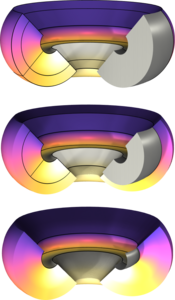
This tutorial model demonstrates the use of the features for heat transfer in layered shells, to account for the curvature of the layers when applying heat fluxes and heat sources. The results obtained with the Heat Transfer in Shells interface applied to a boundary (with extra ... Mehr lesen

Nucleate boiling occurs when a liquid is heated by a source hotter than the saturated fluid temperature but with a heat flux below the critical heat flux. In this regime, high heat flux are possible due to the evaporation of the liquid. This model aims to demonstrate the calculation of ... Mehr lesen

This model is used on "Heat Transfer with Radiation in Participating Media and the Discrete Ordinates Method" to compare quadrature sets used in the method of discrete ordinates. The reference analytical solution of incident irradiation is obtained with 256 discrete directions. Errors in ... Mehr lesen
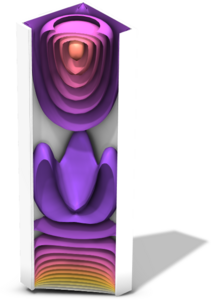
A smoke exhaust duct in a building is analyzed. Radiation of a non-gray gas is accounted for with a Radiation in Participating Media interface and the Weighted Sum of Gray Gases Model (WSGG). The smoke exhaust duct consists of 25 mm plaster walls. Building codes require that the walls ... Mehr lesen
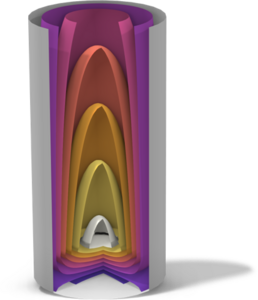
Inside of a combustion chamber, the gas mix behaves as a non-gray medium. Such media require a lot of data and computational resources to get results across the whole spectrum. The Weighted Sum of Gray Gases Model (WSGG) proposes an approach to model the non-gray gas mix as a sum of ... Mehr lesen


