
Die Application Gallery bietet COMSOL Multiphysics® Tutorial- und Demo-App-Dateien, die für die Bereiche Elektromagnetik, Strukturmechanik, Akustik, Strömung, Wärmetransport und Chemie relevant sind. Sie können diese Beispiele als Ausgangspunkt für Ihre eigene Simulationsarbeit verwenden, indem Sie das Tutorial-Modell oder die Demo-App-Datei und die dazugehörigen Anleitungen herunterladen.
Suchen Sie über die Schnellsuche nach Tutorials und Apps, die für Ihr Fachgebiet relevant sind. Beachten Sie, dass viele der hier vorgestellten Beispiele auch über die Application Libraries zugänglich sind, die in die COMSOL Multiphysics® Software integriert und über das Menü File verfügbar sind.
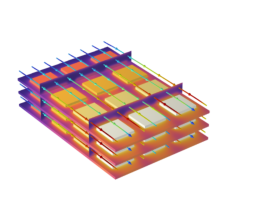
The suite of models examine the air cooling of circuit boards populated with multiple integrated circuits (ICs), which act as heat sources. Two possible cooling scenarios are depicted: vertically aligned boards using natural convection, and horizontal boards with forced convection (fan ... Mehr lesen

In massive forming processes like rolling or extrusion, metal alloys are deformed in a hot solid state with material flowing under ideally plastic conditions. Such processes can be simulated effectively using computational fluid dynamics, where the material is considered as a fluid with ... Mehr lesen
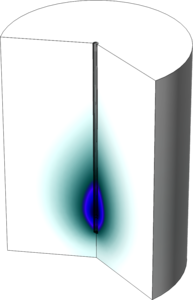
Elektromagnetische Erwärmung ist ideal für die Modellierung in COMSOL Multiphysics geeignet. Dieses Modell zeigt ein Beispiel aus dem Bereich der hyperthermischen Onkologie, aber die Modellierungstechniken sind generell auf jedes Problem anwendbar, das mit elektromagnetischer Erwärmung ... Mehr lesen

Dieses Tutorial-Modell veranschaulicht, wie die thermischen Auswirkungen der Sonne als externe Strahlungsquelle analysiert werden können und berücksichtigt wellenlängenabhängige Oberflächenemissionen. Das Modell enthält zwei Kühlboxen mit Getränkedosen, die den Umgebungsbedingungen ... Mehr lesen
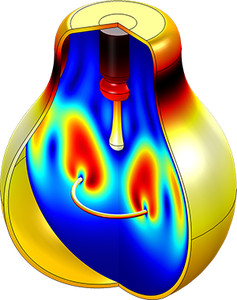
Dieses Modell behandelt die freie Konvektion von Argongas in einer Glühbirne. Es zeigt die Kopplung des Wärmetransports (Leitung, Strahlung und Konvektion) mit dem Impulstransport (nicht-isotherme Strömung), der durch temperaturbedingte Dichteänderungen verursacht wird. Das COMSOL ... Mehr lesen
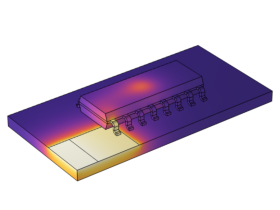
All integrated circuits (ICs) — especially high-speed devices — produce heat. In today’s dense electronic system layouts, heat sources are many times placed close to heat-sensitive ICs. Designers of printed circuit boards often need to consider the relative placement of heat ... Mehr lesen
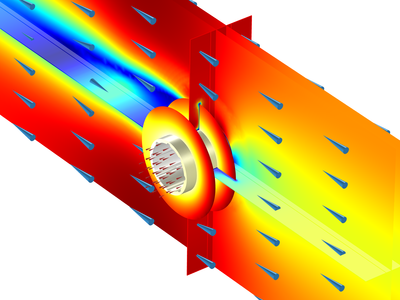
This app demonstrates the following: Geometry parts and parameterized geometry A results table form object containing outputs Finned pipes are used for coolers, heaters, or heat exchangers to increase heat transfer. They come in different sizes and designs depending on the ... Mehr lesen

When producing glass, the glass melt is cooled down through radiation to form the final shape, subjecting it to stresses. Numerical treatment of radiative heat transfer, using the Radiative Transfer Equation (RTE), helps to optimize this process. COMSOL Multiphysics provides three ... Mehr lesen
This 2D stationary model computes heat and moisture transport in a wall composed of different hygroscopic materials. A comparison with the Glaser method is given for the temperature and relative humidity solutions. The effect of the use of a vapor barrier is also investigated. Mehr lesen

Die Trocknung poröser Medien ist ein wichtiger Prozess unter anderem in der Lebensmittel- und Papierindustrie. Viele physikalische Effekte müssen berücksichtigt werden: Strömung, Wärmetransport mit Phasenwechsel und Transport der beteiligten Flüssigkeiten und Gase. Alle diese Effekte ... Mehr lesen


