
Die Application Gallery bietet COMSOL Multiphysics® Tutorial- und Demo-App-Dateien, die für die Bereiche Elektromagnetik, Strukturmechanik, Akustik, Strömung, Wärmetransport und Chemie relevant sind. Sie können diese Beispiele als Ausgangspunkt für Ihre eigene Simulationsarbeit verwenden, indem Sie das Tutorial-Modell oder die Demo-App-Datei und die dazugehörigen Anleitungen herunterladen.
Suchen Sie über die Schnellsuche nach Tutorials und Apps, die für Ihr Fachgebiet relevant sind. Beachten Sie, dass viele der hier vorgestellten Beispiele auch über die Application Libraries zugänglich sind, die in die COMSOL Multiphysics® Software integriert und über das Menü File verfügbar sind.
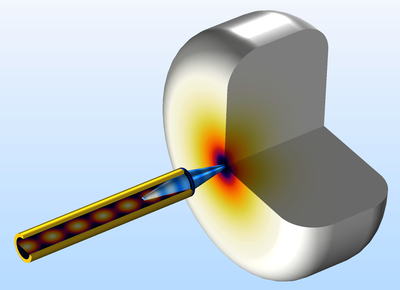
Es ist bekannt, dass die Antwort einer Millimeterwelle mit Frequenzen von 35 GHz und 95 GHz sehr empfindlich auf den Wassergehalt reagiert. Dieses Modell nutzt eine 35-GHz-Ka-Band-Millimeterwelle mit geringer Leistung und ihre Reflektivität gegenüber Feuchtigkeit für die nichtinvasive ... Mehr lesen
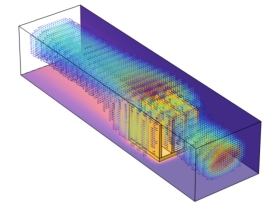
Dieses Tutorial-Modell verwendet eine Kühlkörpergeometrie aus der Part Library. Das Tutorial zeigt verschiedene Ansätze zur Modellierung des Wärmetransports bei der Untersuchung der Kühlung eines elektronischen Chips. Im ersten Teil werden nur die festen Teile modelliert, während der ... Mehr lesen
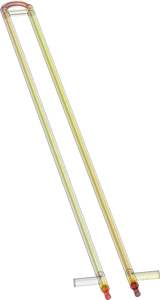
Double-pipe heat exchangers, with their typical U-turn shape, are one of the simplest and cheapest type of heat exchangers used in the chemical process industry. This example studies the cooling of hot oil (130°C) by a cool oil (60°C) entering in counter-current. As the oils flow ... Mehr lesen
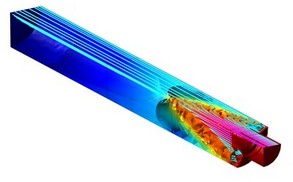
This example models the casting process of a metal rod from liquid to solid state using the Non-Isothermal Flow multiphysics interface, which combines heat transfer and fluid flow. The model describes the fluid and solid flow and heat transport, including the phase transfer from melt to ... Mehr lesen
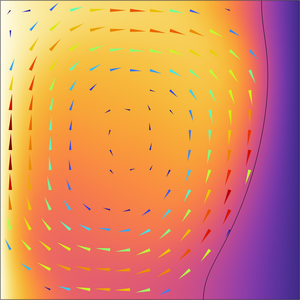
This example demonstrates how to model phase transition by a moving boundary interface according to the Stefan problem. A square cavity containing both solid and liquid tin is submitted to a temperature difference between left and right boundaries. Fluid and solid parts are solved in ... Mehr lesen

Thermoelectric elements are often used to cool or heat electronic components to a desired temperature. In such simulations, you are typically not interested in the behavior of the thermoelectric element itself but want to use its performance characteristics to model the overall response ... Mehr lesen

Dieses Tutorial zeigt, wie Sie drei Physik-Interfaces koppeln können, um die Verdunstungskühlung zu modellieren. Die zu berücksichtigenden Effekte sind der Wärmetransport, der Transport von Wasserdampf und die Strömung. Das Feature Wet Surface wird verwendet, um den Quellterm für den ... Mehr lesen
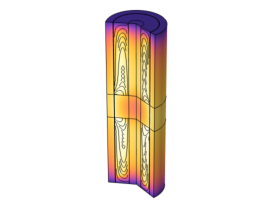
Fluid dampers are used in military devices for shock isolation and in civil structures for suppressing earthquake-induced shaking and wind-induced vibrations, among many other applications. Fluid dampers work by dissipating the mechanical energy into heat. This model shows the phenomenon ... Mehr lesen
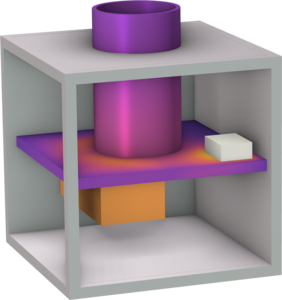
This model demonstrates how to compute satellite temperature over multiple orbit periods by coupling Orbital Thermal Loads to Heat Transfer in Solids. The direct solar, albedo, and Earth infrared thermal loads are computed over a single orbit, and are periodically repeated over multiple ... Mehr lesen
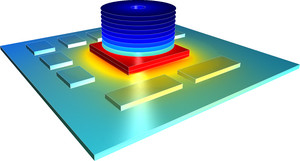
This problem follows a typical preliminary board-level thermal analysis. First perform a simulation of the board with some Integrated Circuits (ICs). Then, add a disk-stack heat sink to observe cooling effects. Finally, explore adding a copper layer to the bottom of the board in order to ... Mehr lesen


