
Die Application Gallery bietet COMSOL Multiphysics® Tutorial- und Demo-App-Dateien, die für die Bereiche Elektromagnetik, Strukturmechanik, Akustik, Strömung, Wärmetransport und Chemie relevant sind. Sie können diese Beispiele als Ausgangspunkt für Ihre eigene Simulationsarbeit verwenden, indem Sie das Tutorial-Modell oder die Demo-App-Datei und die dazugehörigen Anleitungen herunterladen.
Suchen Sie über die Schnellsuche nach Tutorials und Apps, die für Ihr Fachgebiet relevant sind. Beachten Sie, dass viele der hier vorgestellten Beispiele auch über die Application Libraries zugänglich sind, die in die COMSOL Multiphysics® Software integriert und über das Menü File verfügbar sind.

This example describes the cooling and solidification, from melt to solid metal, in a continuous casting process. The model includes nonisothermal properties, temperature distribution, flow field, and phase change. This example uses the arbritrary Lagrangian-Eulerian method for modeling ... Mehr lesen
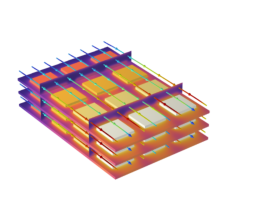
The suite of models examine the air cooling of circuit boards populated with multiple integrated circuits (ICs), which act as heat sources. Two possible cooling scenarios are depicted: vertically aligned boards using natural convection, and horizontal boards with forced convection (fan ... Mehr lesen
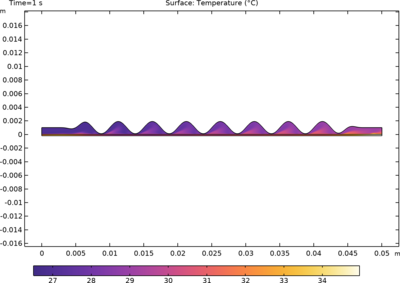
The heat exchanger in this tutorial model contains a dynamic wall with an oscillating wave shape. The deformation induces mixing in the fluid and reduces the formation of thermal boundary layers. Hence, it increases heat transfer between the walls and the fluid. In addition, the wave ... Mehr lesen
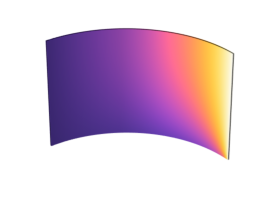
This model simulates a static analysis of heat conduction in a thin conductive shell. This is a benchmark model where the result is compared with a NAFEMS benchmark solution. Mehr lesen
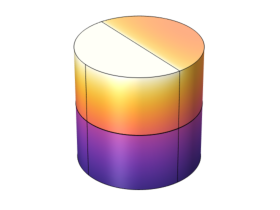
This example shows how to set up multiple sandwiched thin layers with different thermal conductivities in two different ways. First, the composite is modeled as a 3D object. In the second approach, the thin domains are modeled with thermal resistors in the Lumped Thermal System ... Mehr lesen
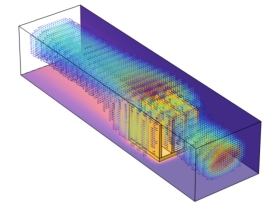
Dieses Tutorial-Modell verwendet eine Kühlkörpergeometrie aus der Part Library. Das Tutorial zeigt verschiedene Ansätze zur Modellierung des Wärmetransports bei der Untersuchung der Kühlung eines elektronischen Chips. Im ersten Teil werden nur die festen Teile modelliert, während der ... Mehr lesen

During the design of a building, environmental issues have gained considerable influence in the entire project. One of the first concerns is to improve thermal performances. In this process, simulation software are key tools to model thermal losses and performances in the building. The ... Mehr lesen
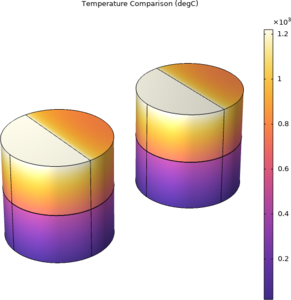
This example is a variant of the Composite Thermal Barrier tutorial and shows how to set up multiple sandwiched thin layers with different thermal conductivities in two different ways. First, the composite is modeled as a 3D object. In the second approach the Lumped Thermal System ... Mehr lesen
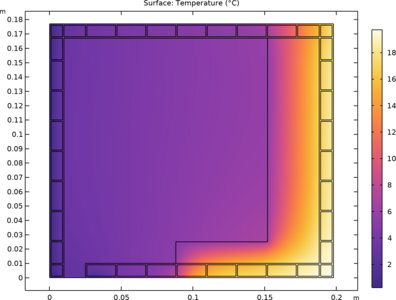
During the design of a building, environmental issues have gained considerable influence in the entire project. One of the first concerns is to improve thermal performances. In this process, simulation software are key tools to model thermal losses and performances in the building. The ... Mehr lesen
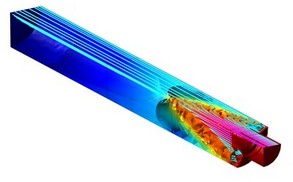
This example models the casting process of a metal rod from liquid to solid state using the Non-Isothermal Flow multiphysics interface, which combines heat transfer and fluid flow. The model describes the fluid and solid flow and heat transport, including the phase transfer from melt to ... Mehr lesen


