
Die Application Gallery bietet COMSOL Multiphysics® Tutorial- und Demo-App-Dateien, die für die Bereiche Elektromagnetik, Strukturmechanik, Akustik, Strömung, Wärmetransport und Chemie relevant sind. Sie können diese Beispiele als Ausgangspunkt für Ihre eigene Simulationsarbeit verwenden, indem Sie das Tutorial-Modell oder die Demo-App-Datei und die dazugehörigen Anleitungen herunterladen.
Suchen Sie über die Schnellsuche nach Tutorials und Apps, die für Ihr Fachgebiet relevant sind. Beachten Sie, dass viele der hier vorgestellten Beispiele auch über die Application Libraries zugänglich sind, die in die COMSOL Multiphysics® Software integriert und über das Menü File verfügbar sind.
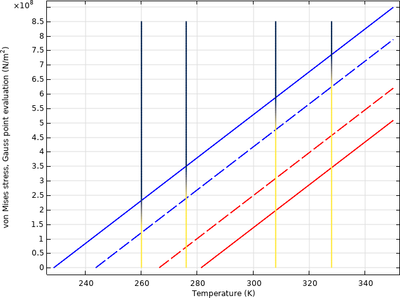
The model includes a compilation of benchmark examples included in the text book: Shape Memory Alloys: Modeling and Engineering Applications. D. Lagoudas Ed. Springer 2008. The model uses the Souza–Auricchio model and shows the thermomechanical properties of a NiTi alloy sample ... Mehr lesen

The elastoacoustic effect is a change in the speed of elastic waves that propagate in a structure undergoing static elastic deformations. The effect is used in many ultrasonic techniques for nondestructive testing of prestressed states within structures. This example studies the ... Mehr lesen
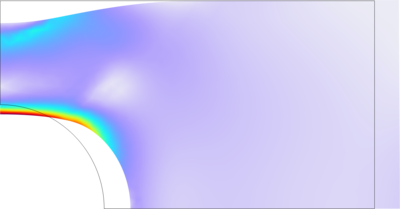
This example shows the analysis of a perforated plate loaded into the plastic regime. Part of the example is a benchmark, which you can find in section 7.10 of The Finite Element Method by O.C. Zienkiewicz. The unloading of the plate and residual stresses are also studied. In a second ... Mehr lesen

In this example, wrinkling is studied in a cylindrical membrane of nonuniform thickness under axial and pressure loading. The membrane is modeled as an incompressible Mooney–Rivlin material. During axial stretching, certain portions of the membrane undergo wrinkling; however, the ... Mehr lesen

The model includes a compilation of benchmark examples included in the text book: Shape Memory Alloys: Modeling and Engineering Applications. D. Lagoudas Ed. Springer 2008. The model shows the thermomechanical properties of a NiTi alloy sample subjected to uniaxial tension-compression ... Mehr lesen
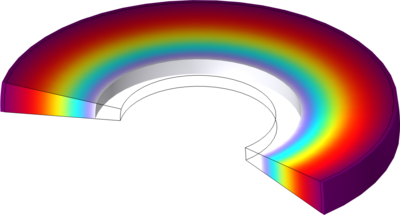
Creep is an inelastic time-dependent deformation which occurs when a material is subjected to stress at sufficiently high temperature, say 40% of the melting point or more. Experimental creep data (using constant stress and temperature) often display three different types of behavior ... Mehr lesen
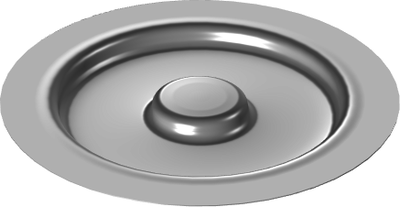
Die forming is a widespread sheet metal forming manufacturing process. The workpiece, usually a metal sheet, is permanently reshaped around a die through plastic deformation by forming and drawing processes. Simulations can be carried out in order to avoid cracks, tears, wrinkles, too ... Mehr lesen
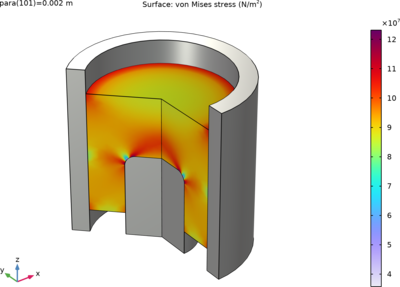
The fabrication of a cup through powder compaction is simulated in this tutorial model. The powder compaction process is becoming common in the manufacturing industry, due to its potential for producing components of complex shape and high strength. Combining the Fleck–Kuhn–McMeeking ... Mehr lesen
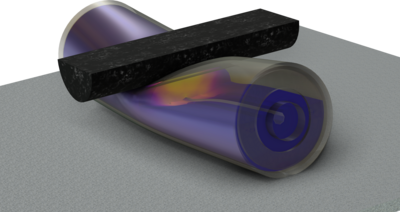
Eindrücktests werden häufig zur Bewertung der Sicherheit von Batterien eingesetzt, indem das Risiko interner Kurzschlüsse unter äußeren mechanischen Belastungen beurteilt wird. Dieses Beispiel veranschaulicht, wie ein solcher Versuch aufgebaut wird, bei dem ein Eindrückkörper auf eine ... Mehr lesen
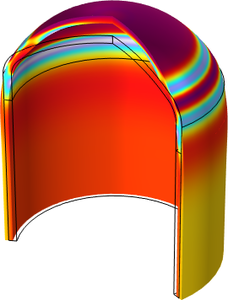
A thin-walled container made of rolled steel is subjected to an internal overpressure. As an effect of the manufacturing method, one of the three material principal directions — the out-of- plane direction — has a higher yield stress than the other two. Hill’s orthotropic plasticity is ... Mehr lesen


