
Die Application Gallery bietet COMSOL Multiphysics® Tutorial- und Demo-App-Dateien, die für die Bereiche Elektromagnetik, Strukturmechanik, Akustik, Strömung, Wärmetransport und Chemie relevant sind. Sie können diese Beispiele als Ausgangspunkt für Ihre eigene Simulationsarbeit verwenden, indem Sie das Tutorial-Modell oder die Demo-App-Datei und die dazugehörigen Anleitungen herunterladen.
Suchen Sie über die Schnellsuche nach Tutorials und Apps, die für Ihr Fachgebiet relevant sind. Beachten Sie, dass viele der hier vorgestellten Beispiele auch über die Application Libraries zugänglich sind, die in die COMSOL Multiphysics® Software integriert und über das Menü File verfügbar sind.

This model demonstrates the application of COMSOL Multiphysics to a benchmark case of steady-state subsurface fluid flow and transient solute transport along a vertical cross section in an unconfined aquifer. Because of profound geologic heterogeneity, the model must estimate solute ... Mehr lesen
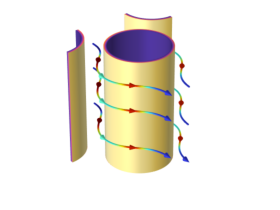
This model studies a part of a shell-and-tube heat exchanger where hot water enters from above. The cooling medium flows through the tubes that, in this model, impose a constant temperature at the walls. Furthermore, the tubes are assumed to be made of stainless steel and the heat flux ... Mehr lesen
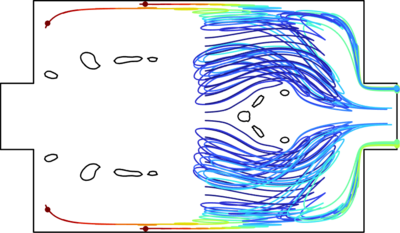
This example performs a topological optimization for a Tesla microvalve for an oscillating pressure drop. A Tesla microvalve inhibits backward flow using friction forces rather than moving parts, and therefore the objective is to maximize the average flow rate. The design can be ... Mehr lesen
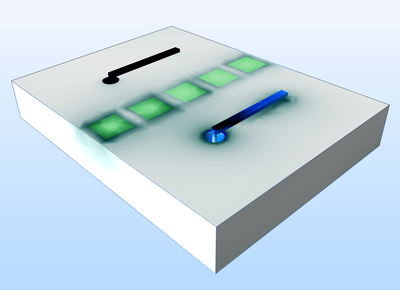
An Electromagnetic Band Gap (EBG) structure can be used to increase the isolation between antennas close to each other. The decoupling effect is not only a function of frequency but also polarization and coupling-plane configuration. When designing an EBG structure, one needs to make ... Mehr lesen
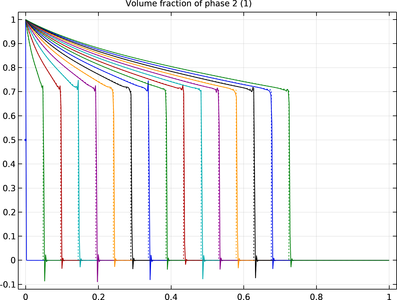
This benchmark models two-phase flow in a porous medium in 1D, where the flow can be analytically described by the Buckley-Leverett equation. Mehr lesen
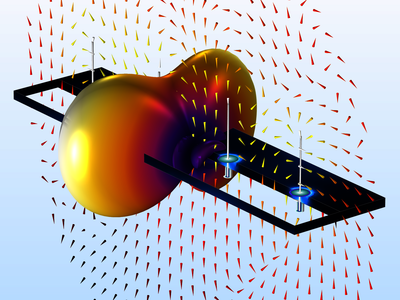
It is possible to shape the radiation pattern and steer the beam from an antenna array by controlling the relative phases and magnitudes of the input signal. This example shows how to design an active electronically scanned array (AESA) using arithmetic phase progression on each antenna ... Mehr lesen

This app demonstrates the following: Visualization of a periodic structure from a unit cell Resetting some or all input parameters Export the resulting material properties as an MPH-file or an XML-file that can be imported to a COMSOL Multiphysics session Periodic microstructures are ... Mehr lesen
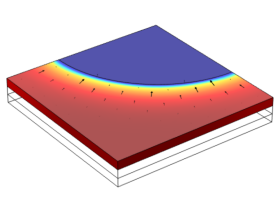
This example extends the Fuel Cell Cathode tutorial to also include liquid water transport in the oxygen electrode. Liquid water is produced using a user-defined expression for vapor condensation, depending on the relative humidity level in the gas phase. An experimental capillary ... Mehr lesen
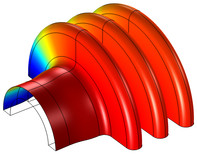
A cooling flange in a chemical process is used to cool the process fluid, which flows through the flange. The surrounding air cools the flange via natural convection. In the stationary model, the forced convection to the process fluid is modeled using a constant heat transfer ... Mehr lesen

A contactor wedge is subject to a gravity load and is forced to slide due to a boundary load over a rigid target wedge surface, both infinitely wide. Horizontal linear springs are also connected between the left vertical boundary and the ground. This is a large sliding problem including ... Mehr lesen


