
Die Application Gallery bietet COMSOL Multiphysics® Tutorial- und Demo-App-Dateien, die für die Bereiche Elektromagnetik, Strukturmechanik, Akustik, Strömung, Wärmetransport und Chemie relevant sind. Sie können diese Beispiele als Ausgangspunkt für Ihre eigene Simulationsarbeit verwenden, indem Sie das Tutorial-Modell oder die Demo-App-Datei und die dazugehörigen Anleitungen herunterladen.
Suchen Sie über die Schnellsuche nach Tutorials und Apps, die für Ihr Fachgebiet relevant sind. Beachten Sie, dass viele der hier vorgestellten Beispiele auch über die Application Libraries zugänglich sind, die in die COMSOL Multiphysics® Software integriert und über das Menü File verfügbar sind.
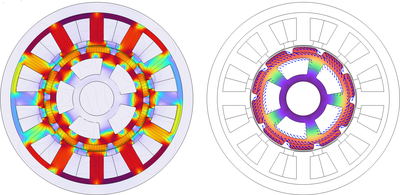
In diesem Beispiel wird die Kopplung zwischen Multibody Dynamics und Rotating Machinery, Magnetic zur Durchführung elektromagnetischer und mechanischer Analysen demonstriert. Ein Permanentmagnetmotor mit 10 Rotorpolen und 12 Statornuten wird in 2D modelliert. Die Magnete sind am Umfang ... Mehr lesen

This example illustrates the modeling of ply drop-off in a composite panel. The panel considered for the analysis has three sections–thick, taper, and thin. The thick section plies are divided into the core, top-bottom belts, and dropped plies. The thick section of the panel has sixteen ... Mehr lesen

This example shows how to implement a stress dependent material model. The Young's modulus changes based on the stress value. Mehr lesen
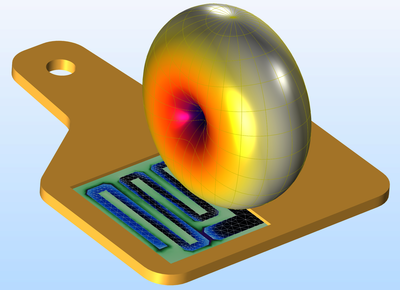
UHF RFID tags are widely used for identifying and tracking animals. This model simulates a passive radio-frequency identification (RFID) tag for the UHF frequency range. With respect to the chip transponder’s complex impedance, a reflection coefficient is computed. This is done using an ... Mehr lesen
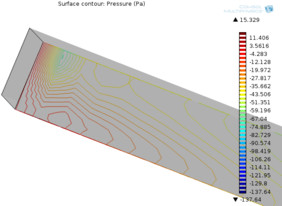
A lab-on-a-chip platform can be realized on a rotating disc by designing channels and other features to use the Coriolis or centrifugal forces to manipulate the flow. These forces are controlled by changing the angular velocity of the disc, so the platform is programmed by using a ... Mehr lesen
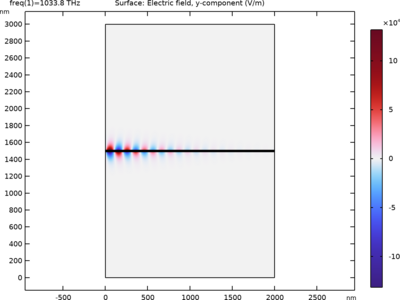
This model demonstrates how to simulate surface plasmon polaritons in a thin metal layer embedded in dielectric layers. It calculates the dispersion and propagation length of surface plasmon polaritons as a function of photon energy. Mehr lesen
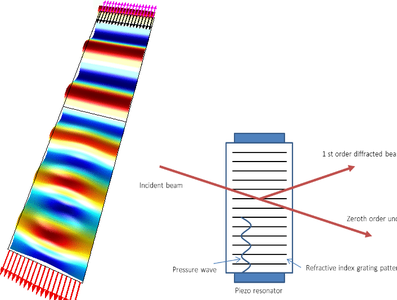
An acousto-optic modulator (AOM) is a device which can be used for controlling the power, frequency or spatial direction of a laser beam with an electrical drive signal. It is based on the acousto-optic effect, that is, the modification of the refractive index by the oscillating ... Mehr lesen
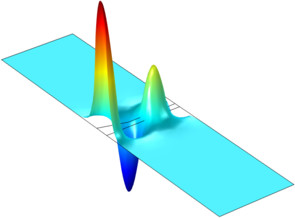
Quantum dots are nano- or microscale devices created by confining free electrons in a 3D semiconducting matrix. Those tiny islands or droplets of confined “free electrons” (those with no potential energy) present many interesting electronic properties. They are of potential importance ... Mehr lesen
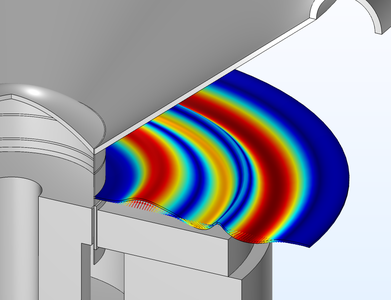
Die Aufhängung eines Lautsprechers ist so konzipiert, dass sie die Membran an Ort und Stelle hält und ein Schaukeln der Schwingspule verhindert. Bei niedrigen Frequenzen, bei denen die Auslenkung der Membran erheblich ist, variiert die Steifigkeit der Aufhängung entlang der Bewegung der ... Mehr lesen
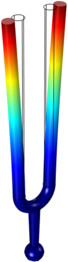
Wenn eine Stimmgabel angeschlagen wird, schwingt sie in einem komplexen Bewegungsmuster, das mathematisch als Überlagerung von Resonanzmoden, auch Eigenmoden genannt, beschrieben werden kann. Jede Mode ist mit einer bestimmten Eigenfrequenz verbunden. Die Stimmgabel erzeugt ihren ... Mehr lesen


