
Die Application Gallery bietet COMSOL Multiphysics® Tutorial- und Demo-App-Dateien, die für die Bereiche Elektromagnetik, Strukturmechanik, Akustik, Strömung, Wärmetransport und Chemie relevant sind. Sie können diese Beispiele als Ausgangspunkt für Ihre eigene Simulationsarbeit verwenden, indem Sie das Tutorial-Modell oder die Demo-App-Datei und die dazugehörigen Anleitungen herunterladen.
Suchen Sie über die Schnellsuche nach Tutorials und Apps, die für Ihr Fachgebiet relevant sind. Beachten Sie, dass viele der hier vorgestellten Beispiele auch über die Application Libraries zugänglich sind, die in die COMSOL Multiphysics® Software integriert und über das Menü File verfügbar sind.
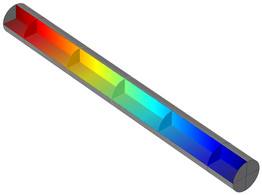
Jedes elektrische Gerät hat einen gewissen Widerstand. Das heißt, wenn eine Spannungsdifferenz zwischen zwei Anschlüssen des Geräts angelegt wird, fließt ein direkt proportionaler Strom. Dieses Modell zeigt, wie der Widerstand eines kurzen Kupferdrahtabschnitts berechnet werden kann. Die ... Mehr lesen
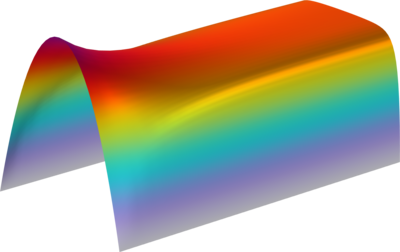
Classical MHD benchmark problem was solved analytically by J. Hartmann. He considered laminar incompressible flow between two planes (in planar duct) in transversal imposed magnetic field under next assumptions: * fully developed flow (far from inlet) * fluid properties are constant * ... Mehr lesen

Chain drives are used for transmitting power from one shaft to another, located at some distance. This example simulates the dynamics of a chain sprocket assembly in 2D. The geometry consists of a roller chain wrapped around two sprockets. Both chain links and sprockets are assumed to be ... Mehr lesen
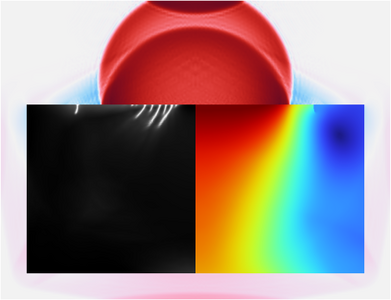
An acoustic point source emits a pressure wave in water that travels toward a piece of glass. Cracks are formed and propagate due to high tensile stresses developed in the glass. A fully coupled acoustic-structure interaction problem including phase field damage in solids is solved in ... Mehr lesen
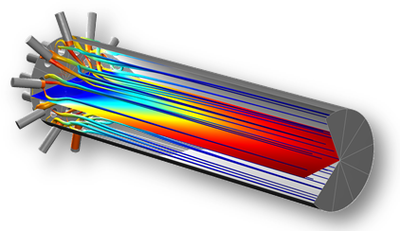
In a polymerization reactor for polyester manufacturing, the mixing in the reactor is achieved by impinging turbulent jets of reactants onto each other. The turbulence affects the reaction kinetics and quality of the polymer linkage. Turbulent flows involving rapid reaction kinetics are ... Mehr lesen
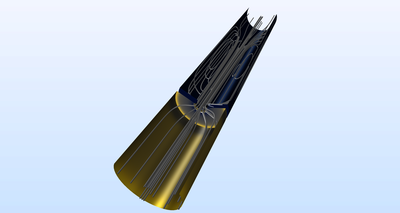
This example considers the turbulent flow of an oil-water suspension through an orifice. The oil droplets are broken up into smaller droplets by the turbulent stresses as the suspension passes through the orifice. The aim of this model is to track the distribution of droplet sizes. The ... Mehr lesen
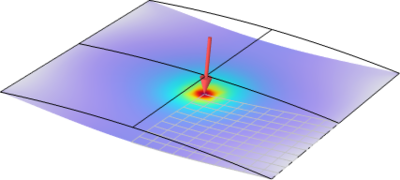
For slender structures, buckling can be a catastrophic instability if the service load exceeds the critical buckling load. For such structures, it can be important to study the structural behavior beyond the critical buckling load. Such a study is known as a postbuckling analysis. ... Mehr lesen
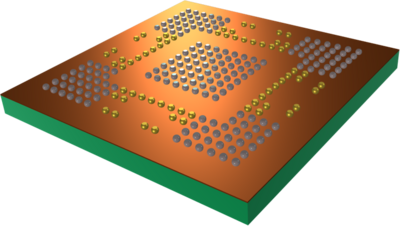
The ball grid array (BGA) technology is a surface-mount technology widely used in electronic packaging. Usually, there are two types of solder balls considered in the array, including the functional balls that are required for electric connections and the support balls that are used only ... Mehr lesen
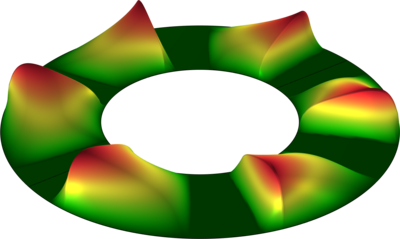
In this tutorial model, a six-step thrust bearing is analyzed. A step thrust bearing consists of a stepped bearing surface on which the end of the shaft rotates. The entire assembly is submerged in a lubricant. The shaft collar is assumed to rotate without any axial motion in the ... Mehr lesen
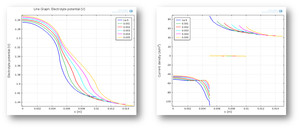
The use of Aluminum (Al) isolator is a commonly employed mitigation strategy for galvanic corrosion between magnesium alloy (Mg) and mild steel (MS). The present model demonstrates the effect of Al isolator thickness on galvanic corrosion severity using a parametric study. The electrode ... Mehr lesen


