
Die Application Gallery bietet COMSOL Multiphysics® Tutorial- und Demo-App-Dateien, die für die Bereiche Elektromagnetik, Strukturmechanik, Akustik, Strömung, Wärmetransport und Chemie relevant sind. Sie können diese Beispiele als Ausgangspunkt für Ihre eigene Simulationsarbeit verwenden, indem Sie das Tutorial-Modell oder die Demo-App-Datei und die dazugehörigen Anleitungen herunterladen.
Suchen Sie über die Schnellsuche nach Tutorials und Apps, die für Ihr Fachgebiet relevant sind. Beachten Sie, dass viele der hier vorgestellten Beispiele auch über die Application Libraries zugänglich sind, die in die COMSOL Multiphysics® Software integriert und über das Menü File verfügbar sind.
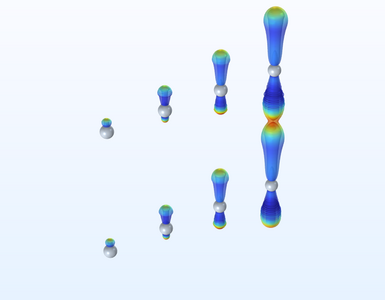
This model simulates the initiation of streamers from suspended metal particles, their propagation under a high electric field, and their subsequent merging. The discharge current flows into the metal particles, which are maintained at equal potential. These suspended particles enhance ... Mehr lesen

This example demonstrates a benchmark test showing that Electric Currents in Layered Shells physics interface can be used to obtain the same results as when the model is solved with the Electric Currents interface based on a solid 3D structure. Mehr lesen
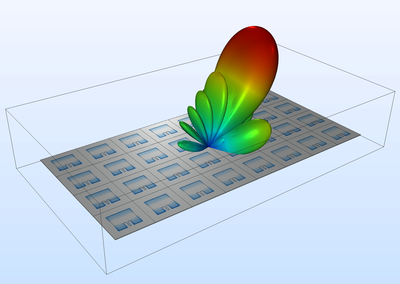
The demand for phased array antennas increases not only for the traditional military industry but also in commercial areas such 5G mobile network platforms, Internet of Things (IoT), and satellite communication applications. This example shows how to design a phased array with a beam ... Mehr lesen
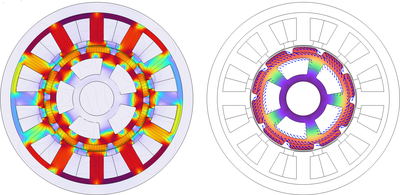
In diesem Beispiel wird die Kopplung zwischen Multibody Dynamics und Rotating Machinery, Magnetic zur Durchführung elektromagnetischer und mechanischer Analysen demonstriert. Ein Permanentmagnetmotor mit 10 Rotorpolen und 12 Statornuten wird in 2D modelliert. Die Magnete sind am Umfang ... Mehr lesen
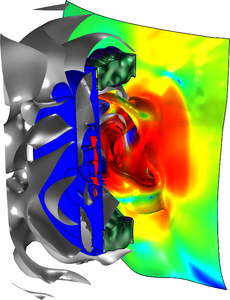
Da Kopfhörer eng an das Ohr gekoppelt sind, ist es nicht möglich, ihre Empfindlichkeit in einem klassischen akustischen Freifeldaufbau zu messen, wie er für Lautsprecher verwendet wird. Die Messung erfordert die Verwendung von künstlichen Köpfen und Ohren, um die Nutzungsbedingungen ... Mehr lesen
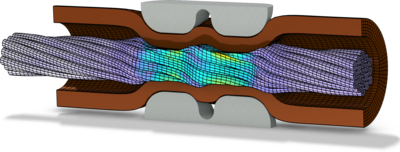
Crimping is the plastic deformation process used to form an electrical joint between a stranded conductor and a terminal. The process involves complex multi-surface contact, including self-contact, as the terminal sleeve is plastically deformed around the wire strands. This example ... Mehr lesen

Joints between two components of a mechanical system are sometimes not perfectly fitting. For the ease of assembly and to allow relative movement between the components, a small gap called clearance is provided between the joining components. The presence of clearance on joints can ... Mehr lesen
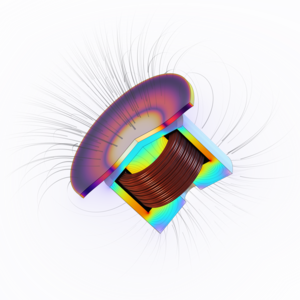
A magnetic diaphragm is a flexible, thin structure that interacts with magnetic fields to perform mechanical or sensing functions. When subjected to an external magnetic field, the diaphragm deforms due to magnetomechanical interactions, converting magnetic energy into mechanical ... Mehr lesen

Thermische Energiespeicher werden zur Speicherung von Wärmeenergie aus Solar-, Geothermie- oder Abwärmequellen verwendet. Die einfachsten Anlagen bestehen aus Wassertanks, die häufig in Haushalten zu finden sind und in denen die Sonnenenergie als fühlbare Wärme gespeichert wird. Die ... Mehr lesen
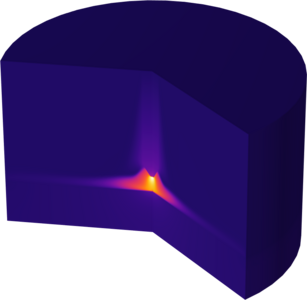
This example investigates the electrical and thermal characteristics of a welding argon arc created in a point-to-plane configuration. The discharge is assumed to be in local thermodynamic equilibrium. The electric arc is considered a conductive fluid medium and is modeled using a ... Mehr lesen


