
Die Application Gallery bietet COMSOL Multiphysics® Tutorial- und Demo-App-Dateien, die für die Bereiche Elektromagnetik, Strukturmechanik, Akustik, Strömung, Wärmetransport und Chemie relevant sind. Sie können diese Beispiele als Ausgangspunkt für Ihre eigene Simulationsarbeit verwenden, indem Sie das Tutorial-Modell oder die Demo-App-Datei und die dazugehörigen Anleitungen herunterladen.
Suchen Sie über die Schnellsuche nach Tutorials und Apps, die für Ihr Fachgebiet relevant sind. Beachten Sie, dass viele der hier vorgestellten Beispiele auch über die Application Libraries zugänglich sind, die in die COMSOL Multiphysics® Software integriert und über das Menü File verfügbar sind.
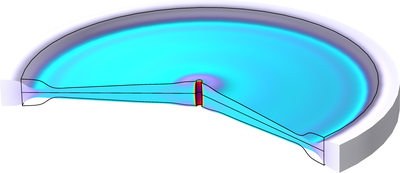
This example solves the problem of finding the optimal thickness profile of a flywheel, so that the moment of inertia is maximized without increasing the mass or the maximum stress in the flywheel. Mehr lesen
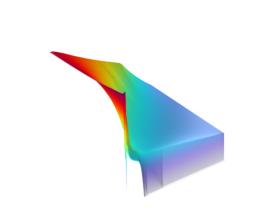
This model solves the Boltzmann equation in two-term approximation for a mixture of nitrogen and oxygen representing a background gas of dry air. Electron transport coefficients and source terms are computed by suitable integration of the electron energy distribution function over ... Mehr lesen
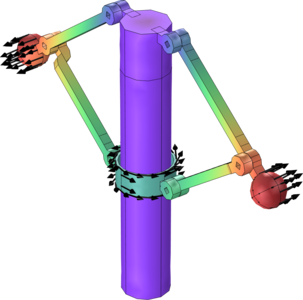
A centrifugal governor is used to control the speed of rotating machinery. One of the most common applications is in controlling the RPM of an engine by regulating the fuel supply. This model illustrates the functioning of a spring loaded centrifugal governor. The dynamics of the ... Mehr lesen
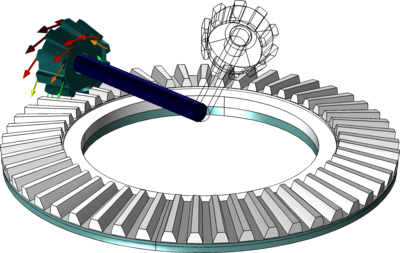
This tutorial model simulates a pair of straight conical bevel gears. The gears are modeled as rigid, but one of the gears is fixed while the other is hinged on a rigid bar. The rigid bar is also hinged at a point lying on the axis of the fixed gear. A transient analysis is performed to ... Mehr lesen

In this model, a turbocharger supported on two floating ring bearings is studied. The film forces on the ring cause it to rotate within the bearing. In steady state, the ring rotates at a constant angular speed and the torque on the ring due to the inner and outer films are balanced. ... Mehr lesen

Breaker and disconnector devices are widely used in AC substations in power systems.In this model, the Electrostatics Interface is used to simulate the electric potential and electric field in a 110kV 3-phase high-voltage switchgear operating at 50 Hz. A surrogate model is also trained ... Mehr lesen
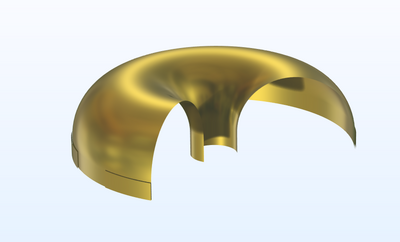
This tutorial demonstrates how to model a gyroscope based on the birdbath resonator gyroscope (BRG) design. The BRG is a type of Coriolis vibratory gyroscope (CVG) invented at the University of Michigan as a navigation-grade gyroscope in the mm-scale. This tutorial shows how the ... Mehr lesen
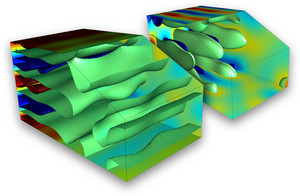
Sound is generated by a point source located in the wall of this test bench car interior. The sound pressure level response at a point of measurement is investigated for a range of frequencies and four different mesh resolutions. The model is first solved with the default direct solvers. ... Mehr lesen
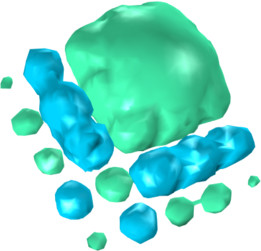
Das Bessel-Array ist eine Möglichkeit, eine Reihe von Lautsprechern so anzuordnen, dass die Winkelschallverteilung der eines einzelnen Lautsprechers ähnelt. Bei diesem Modell werden fünf Bessel-Paneele in demselben Muster kombiniert, um ein rein radiales Schallfeld zu simulieren. Die ... Mehr lesen

MEMS scanning mirrors are a type of MEMS device that realizes optical path control by controlling mirror torsion through a microdriver. The torsion can be single axis or double axis. MEMS scanning mirrors are widely used in laser projection, laser radar, laser processing, and other ... Mehr lesen


