
Die Application Gallery bietet COMSOL Multiphysics® Tutorial- und Demo-App-Dateien, die für die Bereiche Elektromagnetik, Strukturmechanik, Akustik, Strömung, Wärmetransport und Chemie relevant sind. Sie können diese Beispiele als Ausgangspunkt für Ihre eigene Simulationsarbeit verwenden, indem Sie das Tutorial-Modell oder die Demo-App-Datei und die dazugehörigen Anleitungen herunterladen.
Suchen Sie über die Schnellsuche nach Tutorials und Apps, die für Ihr Fachgebiet relevant sind. Beachten Sie, dass viele der hier vorgestellten Beispiele auch über die Application Libraries zugänglich sind, die in die COMSOL Multiphysics® Software integriert und über das Menü File verfügbar sind.

This is a benchmark model involving stick-slip friction of a ring rolling inside another ring. The displacement of the inner ring is computed and compared to the analytical result. This model also shows how to tackle friction dominated contact problem. Mehr lesen
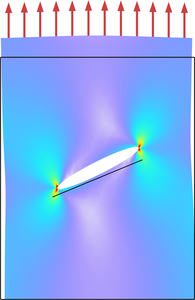
This example reproduces a NAFEMS benchmark in which a plate with an angle crack is subjected to tensile loading. The J-integral is calculated and the stress intensity factors for Mode I and Mode II are compared to the benchmark results for several crack angles. Mehr lesen

This conceptual example shows how to handle a transient contact problem with stick-slip friction transition. A soft hollow pipe subjected to gravity is released at the top of a halfpipe. The pipe motion varies between sliding and rolling, depending on its position in the halfpipe and its ... Mehr lesen
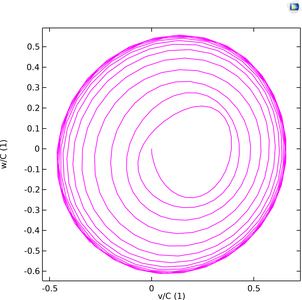
The Whirling of a Uniform Shaft tutorial model shows you how to perform a transient analysis of a uniform shaft under gravity. The shaft is supported by two hydrodynamic bearings at its ends. The gyroscopic effect causes the rotor to whirl about its initial axis and the rotor eventually ... Mehr lesen

Combinations of optical devices such as polarizers and wave retarders can be used to control the intensity and polarization of transmitted radiation. In this tutorial, two linear polarizers with orthogonal transmission axes are used to reduce the intensity of a ray to zero. Then the ... Mehr lesen
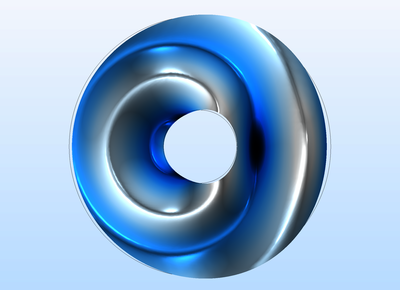
This example model calculates the bistatic radar cross section (RCS) per unit length of a circle using the Electromagnetic Waves, Time Explicit physics interface. A 2D circle is excited by a 200 MHz sinusoidal signal modulated by a temporal Gaussian pulse. A wideband RCS frequency ... Mehr lesen
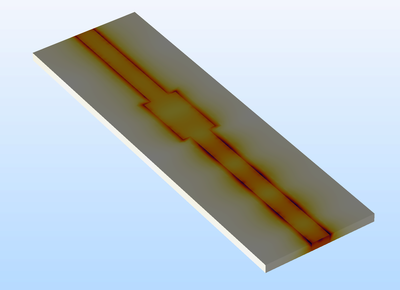
While transient analyses are useful for time domain reflectometry (TDR) to handle signal integrity (SI) problems, many RF and microwave examples are addressed using frequency domain simulations generating S-parameters. However, from the frequency domain data it is difficult to identify ... Mehr lesen
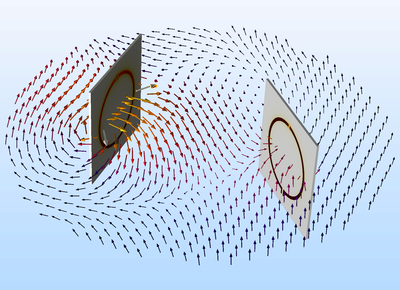
This model addresses the concept of wireless power transfer by studying the energy coupling between two circular loop antennas tuned for UHF RFID frequency whose size is reduced using chip inductors. The circular loop antenna provides inherent inductive coupling by its shape, and it can ... Mehr lesen
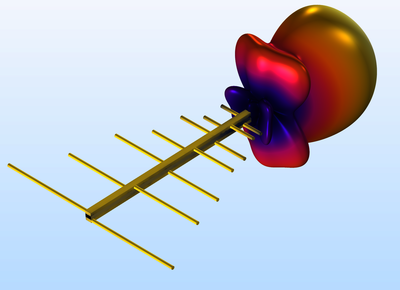
The shape of a log-periodic antenna resembles that of a Yagi-Uda antenna, but is composed of a coplanar array to achieve a wider bandwidth. It is also known as a wideband or frequency-independent antenna. All metallic parts are modeled using the perfect electric conductor (PEC) boundary ... Mehr lesen
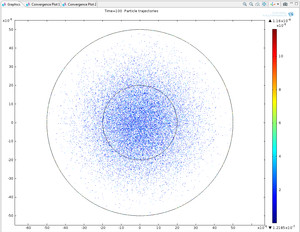
Transport which is purely diffusive in nature can be modeled using a Brownian force. This model shows how to add such a force in the Particle Tracing for Fluid Flow physics interface. Particle diffusion in a fluid is modeled with the diffusion equation and the Particle Tracing for Fluid ... Mehr lesen


