
Die Application Gallery bietet COMSOL Multiphysics® Tutorial- und Demo-App-Dateien, die für die Bereiche Elektromagnetik, Strukturmechanik, Akustik, Strömung, Wärmetransport und Chemie relevant sind. Sie können diese Beispiele als Ausgangspunkt für Ihre eigene Simulationsarbeit verwenden, indem Sie das Tutorial-Modell oder die Demo-App-Datei und die dazugehörigen Anleitungen herunterladen.
Suchen Sie über die Schnellsuche nach Tutorials und Apps, die für Ihr Fachgebiet relevant sind. Beachten Sie, dass viele der hier vorgestellten Beispiele auch über die Application Libraries zugänglich sind, die in die COMSOL Multiphysics® Software integriert und über das Menü File verfügbar sind.
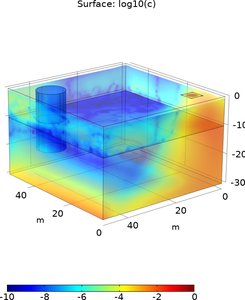
A simple model for groundwater contamination portrays a well that is bored into an aquifer. The aquifer consists of a partially saturated layer and a fully saturated layer. The model investigates how much of the contaminant ends up in the well after a contaminant is introduced in the ... Mehr lesen

Dieses Beispiel simuliert die turbulente Strömung um einen Sportwagen, der mit einer Geschwindigkeit von 180 km/h fährt, mithilfe von Large-Eddy-Simulationen (LES). Mehr lesen
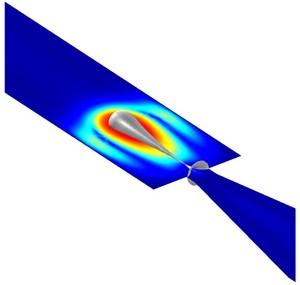
Obwohl sie ursprünglich für den Einsatz in Druckern erfunden wurden, sind Tintenstrahldüsen inzwischen auch in anderen Anwendungsbereichen wie den Biowissenschaften und der Mikroelektronik zu finden. Simulationen können nützlich sein, um das Verständnis der Strömung zu verbessern und das ... Mehr lesen
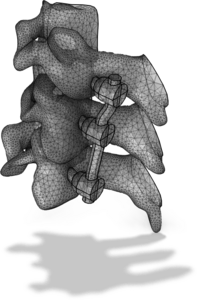
In dieser Tutorial-Serie erfahren Sie, wie Sie mit importierten Oberflächennetzen arbeiten können. Die Anleitung beschreibt, wie Sie STL-Dateien von zwei Wirbeln und einer Bandscheibe importieren und wie Sie Löcher, falsch ausgerichtete Netzpunkte und sich überschneidende Elemente ... Mehr lesen
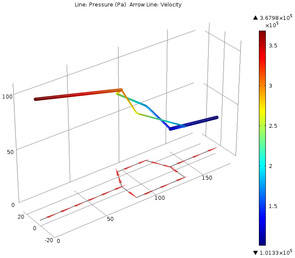
The Pipe Flow interface allows you to simulate non-Newtonian fluids flowing in pipes. This example models a coal slurry being transported in a pipe system where the pipe diameter changes in different sections. The slurry behaves as a non-Newtonian fluid described by the power law model. ... Mehr lesen
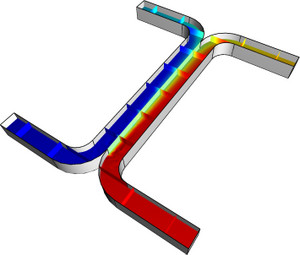
This example was originally formulated by Albert Witarsa under Professor Bruce Finlayson’s supervision at the University of Washington in Seattle. It was part of a graduate course in which the assignment consisted of evaluating the potential of patents in the field of microfluidics ... Mehr lesen
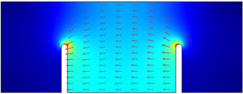
This example treats the modeling of electroosmotic flow in porous media. The system consists of a compartment of sintered porous material and two electrodes that generate an electric field. The cell combines pressure and electroosmotic driven flow. The equations that are solved are the ... Mehr lesen

This benchmark model computes the total force acting on a vibrating disc in the frequency and time domains and compares both results with expressions derived analytically. When the vibration amplitude is small enough that the system is linear the frequency and time domain results agree ... Mehr lesen

The present example simulates the turbulent flow over a 3D hill geometry using the Large Eddy Simulation (LES) interface with synthetic turbulence at the inlet boundary. Mehr lesen

This tutorial model can be used to learn how to calculate mass and energy balances. Get a detailed demonstration in this blog post: How to Calculate Mass Conservation and Energy Balance Mehr lesen


