
Die Application Gallery bietet COMSOL Multiphysics® Tutorial- und Demo-App-Dateien, die für die Bereiche Elektromagnetik, Strukturmechanik, Akustik, Strömung, Wärmetransport und Chemie relevant sind. Sie können diese Beispiele als Ausgangspunkt für Ihre eigene Simulationsarbeit verwenden, indem Sie das Tutorial-Modell oder die Demo-App-Datei und die dazugehörigen Anleitungen herunterladen.
Suchen Sie über die Schnellsuche nach Tutorials und Apps, die für Ihr Fachgebiet relevant sind. Beachten Sie, dass viele der hier vorgestellten Beispiele auch über die Application Libraries zugänglich sind, die in die COMSOL Multiphysics® Software integriert und über das Menü File verfügbar sind.
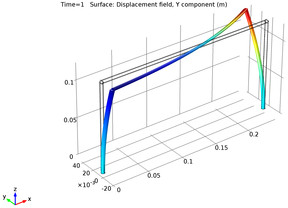
This is a benchmark model for flexible multibody dynamics. This model simulates the dynamic behavior of a planar four-bar mechanism when one of the joints has a defect. The out-of-plane motion in the mechanism, caused by the defect in the joint, is compared with the results from the ... Mehr lesen
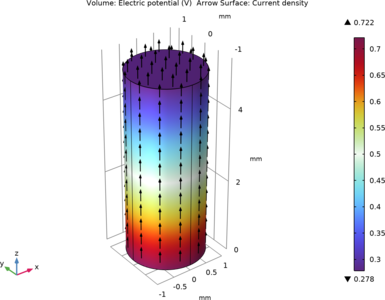
HowTo: Using the EC External I-Terminal The External Couplings in the CIR interface has two flavors that can be used. External I vs. U and External I-terminal. The former has two nodes (it represents a differential external voltage measurement) and when coupling to an EC Terminal ... Mehr lesen
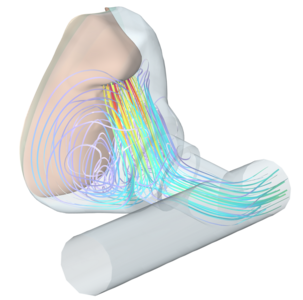
Bei der Entwicklung von Sauerstoffmasken für die Atemunterstützung von Patienten mittels BiPAP und CPAP hilft die Multiphysik-Modellierung dabei, das Strömungsmuster im Inneren der Maske für ein bestimmtes Design zu visualisieren. Auf dieser Grundlage können Sie den Sauerstoffverbrauch, ... Mehr lesen
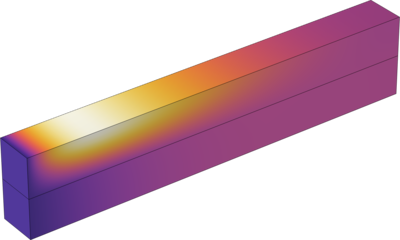
This example models heat generation in a beam-like structure subjected to small amplitude vibrations. The model computes the linear elastic response in the frequency domain. The transient heat-transfer analysis simulates the slow-rising temperature in the beam using the heat generated ... Mehr lesen
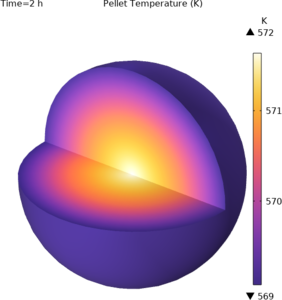
1D model of a thermal energy storage (TES) system consisting of a packed bed of pellets. Three approaches for heat transfer in porous media are compared: A one-equation local thermal equilibrium (LTE) model A two-equations local thermal nonequilibrium (LTNE) model A multiscale ... Mehr lesen
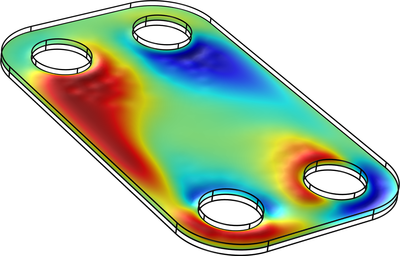
This model demonstrates how to use the built-in shape optimization functionality to improve the performance of a plate heat exchanger. The optimization reduces the path immediately in front of the inlets and outlets to increase the length of typical streamlines. This leads to a improved ... Mehr lesen
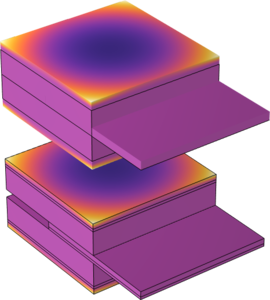
This tutorial model demonstrates the use of the multiphysics coupling feature Thermal Connection, Layered Shell, Surfaces. In this model, three layered shells are connected to heat domains by interior and exterior boundaries. The results obtained with the Heat Transfer in Shells ... Mehr lesen

This model describes a static stress analysis to obtain the stress distribution in the vicinity of a small hole in an infinite plate. The model is a classic benchmark and is described in Mechanics of Material, by D. Roylance. The stress level is then compared with the theoretical values. Mehr lesen


