
Die Application Gallery bietet COMSOL Multiphysics® Tutorial- und Demo-App-Dateien, die für die Bereiche Elektromagnetik, Strukturmechanik, Akustik, Strömung, Wärmetransport und Chemie relevant sind. Sie können diese Beispiele als Ausgangspunkt für Ihre eigene Simulationsarbeit verwenden, indem Sie das Tutorial-Modell oder die Demo-App-Datei und die dazugehörigen Anleitungen herunterladen.
Suchen Sie über die Schnellsuche nach Tutorials und Apps, die für Ihr Fachgebiet relevant sind. Beachten Sie, dass viele der hier vorgestellten Beispiele auch über die Application Libraries zugänglich sind, die in die COMSOL Multiphysics® Software integriert und über das Menü File verfügbar sind.
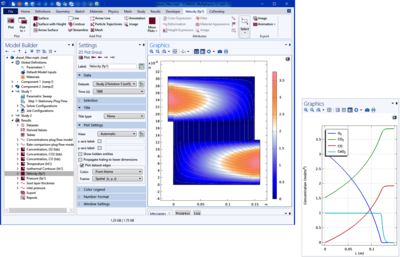
In this tutorial, a filter system for a diesel engine is modeled, including a soot layer development and oxidization. The build-up of the layer is held in check by both catalytic and non-catalytic reactions, where carbon is oxidized to carbon monoxide and carbon dioxide, which in turn ... Mehr lesen
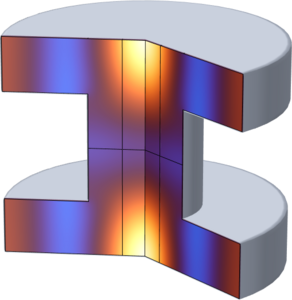
This is a model of a simple photoacoustic (or optoacoustic) resonator. A pulsating laser heats a gas causing expansion and contraction and thus creates pressure waves. Such devices are used as sensors for measuring material parameters of the gas inside the resonator. The resonance ... Mehr lesen
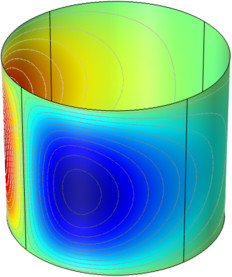
Journal bearings are used to carry radial loads, for example, to support a rotating shaft. A simple journal bearing consists of two rigid cylinders. The outer cylinder (bearing) wraps the inner rotating journal (shaft). The new thin-film flow user interfaces of the CFD Module enables ... Mehr lesen

Wird ein Tropfen auf ein Substrat aufgebracht, auf dem sich akustische Oberflächenwellen ausbreiten, wird deren Energie in den Tropfen übertragen und erzeugt ein akustisches Feld. Die übertragene Energie wird gedämpft und führt zu einer Strömung. Diese Strömung ermöglicht eine ... Mehr lesen
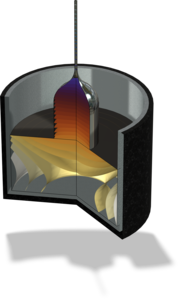
The Czochralski (CZ) method is one of the most important methods for the preparation of monocrystalline silicon. The shape of the crystal, especially the diameter, is controlled by carefully adjusting the heating power, the pulling rate, and the rotation rate of the crystal. This model ... Mehr lesen
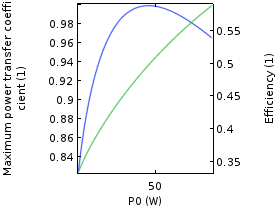
This tutorial drives a capacitively coupled plasma with an L-type matching network at high and low powers. At low power, where the harmonics in the current are low, prefect matching is obtained at the chosen power value. Sweeps over power, frequency, and pressure are performed and their ... Mehr lesen
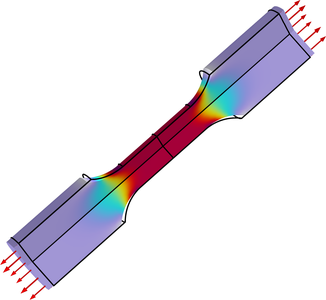
The model shows how to estimate the Young's modulus and Poisson ratio based on a tensile test. The test measures the tensile force and the radial displacement for different values of the prescribed displacement. The model is based on synthetic data generated in the model itself. It is ... Mehr lesen

In complex mechanical systems, it can be challenging to find an optimal (or even good enough) solution only through engineering insight or trial-and-error procedures. Using mathematical optimization methods can then be an efficient path to a better design. In this example, a link ... Mehr lesen


